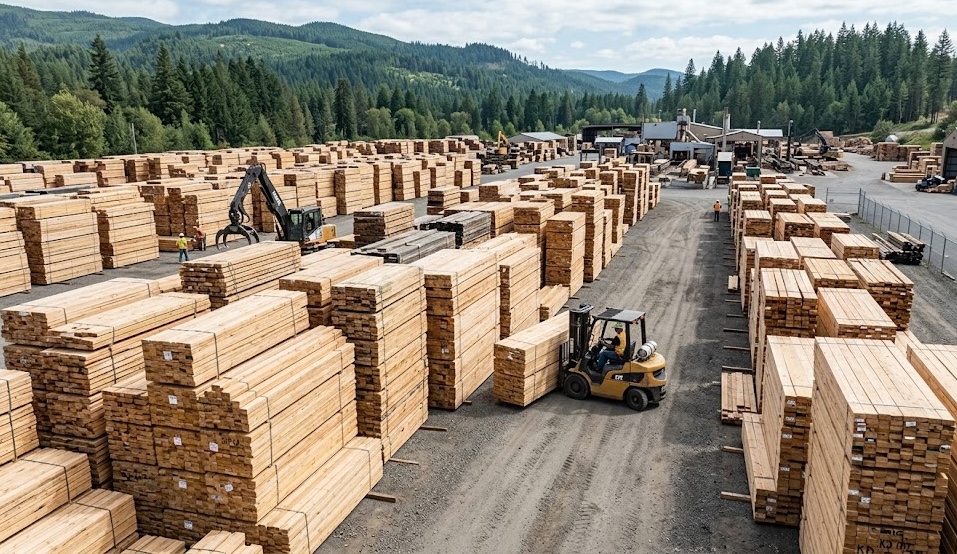
What processing steps do you perform on reclaimed lumber?
We inspect, de-nail, clean, grade, sort, mill, surface, kiln dry, and quality-check reclaimed wood before it is stocked or shipped.
From a rough, nail-studded beam to a smooth, dimensioned board — we handle every step of transforming raw reclaimed timber into usable lumber.
Tell us about your project and we'll get back to you within one business day.
Reclaimed wood doesn't arrive project-ready. It arrives with nails, dirt, weathering, and inconsistent dimensions. Our processing pipeline transforms raw salvaged material into clean, graded, dimensioned lumber that's ready for your project.
Every piece of incoming lumber is visually inspected for species identification, structural soundness, and pest damage. We reject material that doesn't meet our minimum quality standards.
Our crew removes every nail, screw, bolt, and staple by hand. We then clean the wood of dirt, debris, and surface contamination. Metal detection equipment catches embedded fasteners that could damage saw blades.
Each piece is graded for quality and sorted by species, dimension, and intended use. We follow NHLA and WWPA standards adapted for reclaimed material.
Based on demand and inventory needs, lumber is resawn, planed, edged, and profiled. We can produce S2S, S3S, S4S, tongue-and-groove, shiplap, and custom profiles.
When required, we kiln-dry reclaimed lumber to target moisture content (typically 6-8% for interior use, 12-15% for exterior). This ensures dimensional stability and kills any remaining pests.
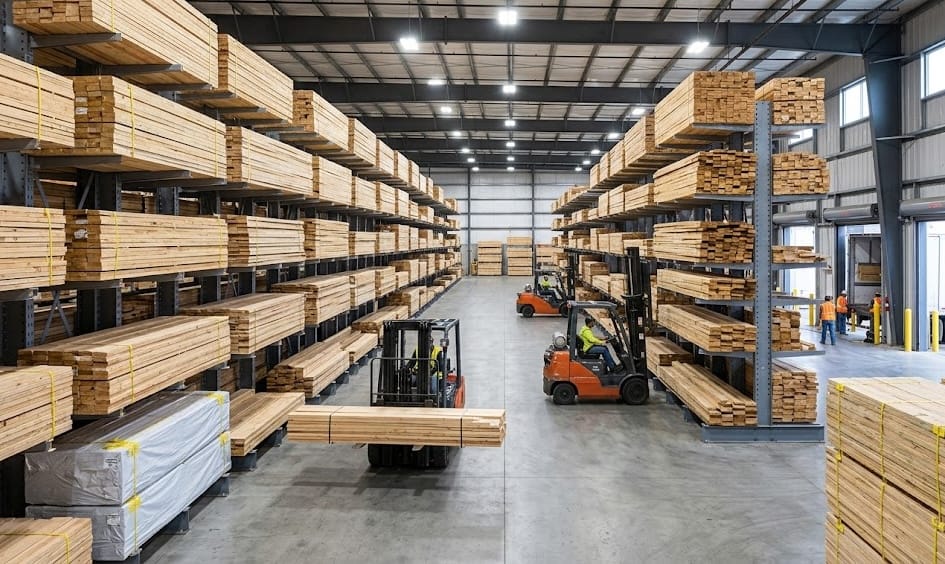
Finished lumber is inspected one final time, then stickered and stacked for proper air circulation. It's labeled by species, grade, dimension, and board footage for easy retrieval.
Our 12,000 sq ft processing facility is equipped with industrial-grade machinery purpose-built for handling the unique challenges of reclaimed lumber — embedded metal, inconsistent dimensions, extreme hardness, and large-format timbers that consumer-grade equipment cannot accommodate.
42" throat capacity, 36" log diameter, 21' bed length. Cuts timbers up to 36" wide in a single pass. Blade speed: 3,000–4,200 FPM. Used for primary resawing of large beams and timbers into dimensional stock.
24" wide capacity, 12" thick capacity. Dual spiral cutterhead with carbide inserts for extended life in nail-scarred wood. 5,000 RPM spindle speed. Produces S2S and S4S finishes to 1/64" tolerance.
4-head moulder, 9.5" wide x 6.3" tall capacity. Produces tongue-and-groove, shiplap, V-groove, and custom profiles in a single pass at up to 60 feet per minute. Quick-change tooling allows profile switches in under 15 minutes.
47" wide cutting capacity, 20 HP motor. Twin-blade configuration for resawing thick slabs into multiple thinner boards simultaneously. Laser guide alignment ensures consistent thickness across the full width.
Custom-built pneumatic station with industrial metal detection (sensitivity to 1/16" ferrous fragments). Three operators process approximately 1,200 BF per shift. Includes rare-earth magnetic sweepers for secondary metal capture.
6,000 BF capacity per charge. Temperature range 90–160°F. Programmable controller with 12 preset and 24 custom drying schedules. Average cycle: 5–10 days for 4/4 stock, 14–21 days for 8/4 and thicker. Moisture content accuracy: ±0.5%.
15,000 CFM capacity, 25 HP blower, baghouse filtration with 99.9% efficiency at 1 micron. Connected to all cutting and planing stations via 12" trunk lines. NFPA 652 compliant for combustible dust management.
5,000 lb capacity, 188" max lift height, pneumatic tires for yard operation. Used for moving lumber bundles between processing stations, loading trucks, and organizing yard inventory.
Pin-type and pinless moisture meters calibrated for 40+ species. Wagner Orion 950 for non-destructive surface readings. Delmhorst J-2000 with 26-ES electrode for deep core readings in heavy timbers. All meters NIST-traceable calibration.
Reclaimed lumber demands higher quality control standards than new material because every piece is unique. Our multi-stage QC process ensures that every board leaving our facility meets clearly defined acceptance criteria.
Typical applications: Flooring, wall cladding, furniture, visible beams, architectural millwork
Typical applications: Structural framing, sheathing, workbench tops, shelving, non-premium installations
Typical applications: Accent walls, rustic furniture, garden structures, artistic installations, props
All grades are inspected at two stages: post-processing and pre-shipment. Material that fails to meet its assigned grade is either reprocessed or downgraded. We maintain a reject rate of less than 3% on finished inventory.
Our facility runs a single shift Monday through Friday with overtime capacity for rush orders. Here's what we can move through the pipeline in a typical production period.
Rush processing available at 1.5x standard rates. Weekend shifts available by arrangement for orders exceeding 10,000 BF with time-critical delivery requirements.
Beyond standard milling, we offer specialty processing techniques that transform reclaimed lumber into distinctive finished products. These treatments are popular with designers and architects seeking unique textures and appearances that can't be replicated with new wood.
Our industrial wire brush system removes soft grain fibers while leaving the harder growth rings intact, creating a deeply textured three-dimensional surface. The process accentuates the natural grain pattern and is especially dramatic on species with distinct growth rings like heart pine and Douglas fir. We offer three levels of brushing intensity — light (surface texture only), medium (1/32" relief), and heavy (1/16" relief). Wire brushing is ideal for wall cladding, ceiling panels, and furniture surfaces where tactile texture is desired.
$0.75 – $1.50/BF depending on intensity
The Japanese technique of charring wood with flame to create a blackened, carbon-rich surface that is naturally weather-resistant and insect-repellent. We use propane torches to char surfaces to three standard depths: light toast (golden brown, grain visible), medium char (dark brown to black, grain texture visible), and deep char (alligator pattern, fully carbonized surface layer). After charring, surfaces are wire-brushed to remove loose carbon and sealed with natural oil. This treatment extends the outdoor service life of softwoods by 10–15 years without chemical preservatives.
$2.00 – $4.00/BF depending on char depth
New or lightly weathered lumber can be aged to match existing reclaimed material using oxidizing solutions, UV exposure, and mechanical distressing. Our aging process uses iron acetate (vinegar and steel wool solution) applied to tannic species like oak and chestnut to produce authentic gray-brown weathered tones in hours rather than decades. We combine chemical oxidation with controlled UV exposure and mechanical wear marks (worm holes, saw kerfs, edge softening) to produce surfaces virtually indistinguishable from naturally aged wood. Essential for blending new material into existing reclaimed installations.
$1.50 – $3.00/BF depending on treatment complexity
Our circular saw setup produces the distinctive arc-shaped saw marks characteristic of 19th-century water- and steam-powered sawmills. This texture cannot be replicated with modern bandsaw or planar equipment. The curved kerf marks catch light differently across the face of the board, creating visual movement and historical authenticity. We run stock through a vintage 48" circular blade at reduced feed rates to produce consistent, deep arc patterns. Available on boards from 3/4" to 3" thick and up to 16" wide.
$1.00 – $2.00/BF
A controlled planing technique where approximately 70–80% of the board face is surfaced flat while leaving shallow recessed areas of the original rough or weathered surface intact. The result is a board that lies flat and installs cleanly while retaining visible patches of original character — patina, saw marks, weathering, and color variation. Skip planing is the most popular finishing option for reclaimed flooring and wall cladding because it delivers the best balance of workability and character.
$0.50 – $1.00/BF
For new or machine-sawn timbers that need to match existing hand-hewn beams, our crew uses traditional hand tools — broadaxes, adzes, and drawknives — to replicate the scalloped, irregular surface created by 18th- and 19th-century timber framers. Each stroke is unique, producing a surface that is genuinely handcrafted. This service is typically requested for fireplace mantels, exposed ceiling beams, and timber-frame accent elements in homes and commercial spaces aiming for historical authenticity.
$4.00 – $8.00/BF (labor-intensive)
The transformation from raw salvaged material to finished product is dramatic. These examples show typical processing outcomes across different material types.
Raw 2x10 floor joists from a 1920s Norfolk warehouse. Nail-studded (8–12 nails per board), surface blackened with 100 years of industrial grime, original bandsaw marks visible beneath dirt. Moisture content: 14–18%. Dimensions inconsistent: actual width ranging 9.25" to 9.75".
Skip-planed 3/4" x 5.5" tongue-and-groove flooring with a #2 Common grade. Rich amber heart pine with tight growth rings (12–16 per inch). Original patina preserved in 20–30% of the surface area. Moisture content: 7%. Uniform dimensions within 1/64" tolerance. Bundled in 250 BF lots.
68% yield (32% lost to nails, edges, defects, and sawdust)
Hand-hewn white oak beams from a Surry County dairy barn, circa 1885. Surfaces deeply weathered with silver-gray patina, original broadaxe marks visible. Surface checking up to 3/8" wide. Multiple 3/4" peg holes. Some bark edge remaining. Moisture content: 22–26%.
Resawn to produce 6x8 feature beams with one original hand-hewn face preserved and three faces surfaced smooth. Also produced 2" thick mantel blanks (6"–8" wide x 60"–72" long) from the outer slabs. Kiln-dried to 8% MC. Light wire-brushing on hewn faces to remove loose fibers. Sealed with penetrating oil. Peg holes and checking preserved as character features.
72% yield — high recovery due to large initial dimensions and premium end-use value
Rock maple (sugar maple) industrial factory flooring from a Richmond shoe factory, circa 1940. Individual strips 2.5" x 3.5" x random lengths (12"–36"), originally installed end-grain-up for wear resistance. Heavily stained with oil, dye, and decades of foot traffic. Extremely hard — Janka rating over 1,450 lbf.
Face-planed to remove surface contamination, then edge-glued into 1.5" thick butcher block panels (25" x 60" standard). The end-grain pattern creates a distinctive checkerboard appearance. Sanded through 220 grit, food-safe mineral oil finish. Each panel contains 40–60 individual strips with subtle color variation from honey to dark caramel.
55% yield — significant loss due to contamination removal and sizing
American chestnut board-and-batten siding from a 1910 tobacco barn in Mecklenburg County. Boards 8"–14" wide, 3/4" thick, random lengths 6'–14'. Exterior face heavily weathered to silver-gray; interior face retains original warm brown tone. Numerous square nail holes. Some boards have circular saw marks.
Lightly cleaned and de-nailed, then resawn through the thickness to produce two thin boards from each original: one with the weathered exterior face (gray side) and one with the warm interior face (brown side). Final thickness: 3/8". Both faces lightly sanded to remove splinters while preserving character. Sold as wall cladding in two colorways: "Barnwood Gray" and "Chestnut Honey." Nail holes, saw marks, and grain patterns intact.
81% yield — minimal processing preserves maximum material
Processing reclaimed lumber presents unique safety hazards not found in standard sawmill operations. Embedded metal, unknown chemical exposures, and variable material properties require heightened awareness and comprehensive safety protocols.
Our facility operates in full compliance with OSHA General Industry Standards (29 CFR 1910), including machine guarding (1910.211–219), electrical safety (1910.301–399), and walking-working surfaces (1910.21–30). We undergo annual third-party safety audits and maintain a Total Recordable Incident Rate (TRIR) below 2.0 — well under the industry average of 4.1 for sawmill and woodworking operations. Our written safety programs include Lockout/Tagout, Hazard Communication, Emergency Action Plan, and Respiratory Protection.
Our 15,000 CFM dust collection system captures wood particles at every cutting, planing, and sanding station. Baghouse filtration achieves 99.9% efficiency at 1 micron, maintaining indoor air quality well below the OSHA PEL for wood dust (5 mg/m³ for softwoods, 1 mg/m³ for hardwoods). We comply with NFPA 652 (Standard on the Fundamentals of Combustible Dust) including regular housekeeping, explosion venting on the dust collector, and grounding of all ductwork to prevent static discharge ignition.
Every piece of reclaimed lumber passes through metal detection before hitting any saw blade. We use a combination of handheld wand detectors and a walk-through conveyor-style detector that scans for ferrous and non-ferrous metals embedded in the wood. Pieces flagged for metal are routed to the de-nailing station for manual extraction. This protocol protects our expensive carbide-tipped saw blades ($800–$2,400 each) and, more importantly, prevents the catastrophic failure of a saw blade striking embedded metal at high speed.
All processing floor personnel are required to wear: steel-toed boots (ASTM F2413), ANSI Z87.1+ rated safety glasses, hearing protection rated NRR 25+ (mandatory near all saws and planers), cut-resistant gloves (ANSI A4 minimum) during material handling, and N95 or P100 respirators when working outside the ducted dust collection zone. High-visibility vests are required in the yard and loading areas. Hard hats are required when forklifts are operating overhead.
Incoming reclaimed lumber with visible paint is tested for lead content using EPA-recognized XRF analyzers before processing. Material testing positive for lead above 0.5% is rejected and returned or disposed of according to EPA guidelines (40 CFR 745). Wood from industrial buildings is screened for creosote, pentachlorophenol, and other chemical treatments. We maintain testing records for every lot processed and can provide material safety documentation to customers upon request.
Wood processing generates fine, combustible dust — one of the top causes of industrial fires and explosions. Our fire prevention program includes: spark detection sensors on all dust collection ductwork, automatic fire suppression (dry chemical) in the dust collector, Class ABC fire extinguishers at every workstation (inspected monthly), no-smoking policy facility-wide, weekly housekeeping audits to prevent dust accumulation on horizontal surfaces, and electrical panel thermographic scanning twice yearly to detect overheating connections.
We process customer-owned material too. Bring us your rough reclaimed timber and we'll mill it to your specifications.
Frequently asked questions about reclaimed lumber cleaning, milling, drying, grading, and custom processing.
We inspect, de-nail, clean, grade, sort, mill, surface, kiln dry, and quality-check reclaimed wood before it is stocked or shipped.
Yes. We process customer-owned material and can mill rough reclaimed timbers or boards to project-specific dimensions and profiles.
Yes. Every piece is de-nailed and scanned for hidden metal before it reaches saws, planers, or moulders.
Yes. We kiln dry reclaimed wood to target moisture levels appropriate for interior or exterior applications to improve stability and pest control.
We produce surfaced lumber, tongue-and-groove, shiplap, custom profiles, and specialty finishes such as wire brushing, charring, and skip planing.