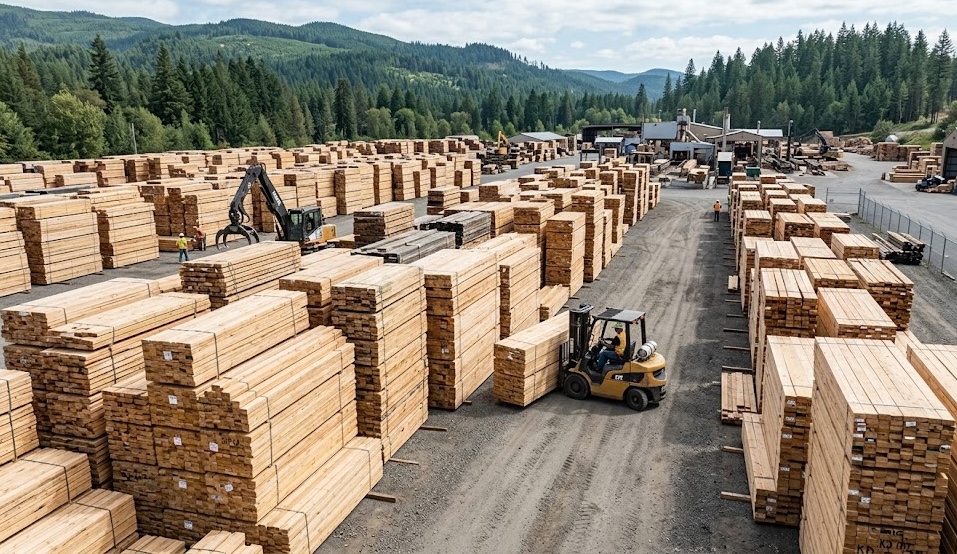
We don't just talk about sustainability — we measure it. Here's the data behind our commitment to keeping wood out of landfills.
Tell us about your project and we'll get back to you within one business day.
Each piece of reclaimed lumber we process represents years of embodied energy, carbon stored, and natural resources preserved. Here's what our work adds up to.
Board Feet Reclaimed
Trees Saved
CO₂ Prevented
Projects Supplied
2.8 million board feet reclaimed — that's enough lumber to frame roughly 175 average American homes. Instead of coming from newly harvested forests, this wood came from demolished buildings, surplus stock, and salvage operations.
4,200+ trees saved — a mature tree produces approximately 660 board feet of usable lumber. By reclaiming and reselling used wood, we've left thousands of trees standing, continuing to filter air, provide habitat, prevent erosion, and sequester carbon.
1,650 tons of CO₂ prevented — this accounts for the carbon that would have been released if the reclaimed wood had decomposed in a landfill, plus the emissions avoided by not logging, milling, and transporting virgin timber as a replacement.
| Factor | Reclaimed Lumber | Virgin Lumber |
|---|---|---|
| CO₂ Emissions | Near zero (transport only) | 1.1 tons CO₂/1000 board feet |
| Water Usage | None (already processed) | 5,400 gallons/1000 board feet |
| Trees Harvested | Zero | ~1.5 trees/1000 board feet |
| Landfill Waste | Diverted from landfill | Creates processing waste |
| Energy Required | Minimal (sorting, milling) | High (logging, sawing, kiln-drying) |
| Dimensional Stability | Excellent (fully seasoned) | Variable (requires drying) |
| Grain Density | Higher (old-growth) | Lower (fast-growth plantation) |
| Character & Patina | Rich, natural, unique | Uniform, requires aging |
Annual reclamation volume
Annual carbon prevention
Energy in all operations
To landfill from our yard
We track our environmental performance on a monthly basis. Here is the detailed breakdown for the past year of operations.
| Month | Board Feet | Trees Saved | CO₂ Prevented | Water Saved | Salvage Ops |
|---|---|---|---|---|---|
| Apr 2025 | 48,200 | 73 | 26.5 tons | 260,280 gal | 6 |
| May 2025 | 52,100 | 79 | 28.7 tons | 281,340 gal | 7 |
| Jun 2025 | 55,800 | 85 | 30.7 tons | 301,320 gal | 8 |
| Jul 2025 | 43,600 | 66 | 24.0 tons | 235,440 gal | 5 |
| Aug 2025 | 47,300 | 72 | 26.0 tons | 255,420 gal | 6 |
| Sep 2025 | 51,900 | 79 | 28.5 tons | 280,260 gal | 7 |
| Oct 2025 | 58,400 | 88 | 32.1 tons | 315,360 gal | 9 |
| Nov 2025 | 44,100 | 67 | 24.3 tons | 238,140 gal | 5 |
| Dec 2025 | 36,200 | 55 | 19.9 tons | 195,480 gal | 4 |
| Jan 2026 | 38,500 | 58 | 21.2 tons | 207,900 gal | 4 |
| Feb 2026 | 42,800 | 65 | 23.5 tons | 231,120 gal | 5 |
| Mar 2026 | 49,600 | 75 | 27.3 tons | 267,840 gal | 7 |
| 12-Mo Total | 568,500 | 862 | 312.7 tons | 3,069,900 gal | 73 |
Board feet measured at point of sale. Trees saved calculated at 660 BF per mature tree. CO₂ at 1.1 tons per 1,000 BF. Water savings at 5.4 gal per BF vs. virgin lumber processing. Salvage operations include barn teardowns, industrial decommissions, and demolition recoveries.
The environmental savings from reclaimed lumber vary significantly based on project scale. Here is the average impact breakdown by project type, based on our data from 840+ completed projects since 2015.
800 - 2,500 BF
0.88 - 2.75 tons
1.2 - 3.8 trees
4,320 - 13,500 gal
Residential projects make up 55% of our orders by count but 35% by volume. The average homeowner orders 1,400 board feet, typically for a combination of flooring and accent features. Even modest residential orders have measurable impact — a single accent wall using 200 board feet of reclaimed wood saves 440 pounds of CO₂ and preserves a third of a mature tree.
Common applications: Accent walls, flooring, mantels, ceiling beams, kitchen islands, bathroom vanities, stair treads, exterior decking
3,000 - 15,000 BF
3.3 - 16.5 tons
4.5 - 22.7 trees
16,200 - 81,000 gal
Commercial interiors are our fastest-growing segment, representing 30% of orders and 45% of volume. A typical restaurant or brewery fitout requires 6,000-8,000 board feet of reclaimed material for bar tops, wall cladding, ceiling treatments, and furniture. These projects prevent an average of 7.7 tons of CO₂ — equivalent to taking 1.7 cars off the road for a full year.
Common applications: Restaurant interiors, brewery taprooms, hotel lobbies, retail stores, office build-outs, coworking spaces
10,000 - 50,000 BF
11 - 55 tons
15.2 - 75.8 trees
54,000 - 270,000 gal
Large institutional projects account for 15% of our orders but 20% of volume. These are high-visibility projects where reclaimed wood makes a statement about the organization's sustainability values. A 25,000-board-foot timber frame structure prevents 27.5 tons of CO₂ — equivalent to taking 6 cars off the road for a year or eliminating 31 round-trip flights between New York and Los Angeles.
Common applications: Timber frame structures, museum installations, public buildings, university facilities, transit stations, park pavilions
Water is the forgotten resource in lumber production. Virgin lumber manufacturing is extraordinarily water-intensive — and reclaimed lumber eliminates nearly all of it.
Producing 1,000 board feet of virgin lumber consumes approximately 5,400 gallons of water across the full supply chain. This includes water used in nursery irrigation for seedling growth, log transport via waterways, sawmill cooling and blade lubrication, kiln humidification systems, and wash-down at processing facilities.
The pulp and paper byproducts of sawmill operations add an additional 2,000-3,000 gallons per 1,000 BF equivalent in water consumption. The total lifecycle water footprint of virgin lumber is one of the most underreported environmental costs in the construction industry.
Reclaimed lumber processing uses approximately 120 gallons per 1,000 board feet — a 97.8% reduction compared to virgin production. This minimal water use comes from our dehumidification kiln (which recirculates moisture rather than consuming fresh water), dust suppression in the yard (using captured rainwater), and equipment cleaning.
At our current annual volume of 520,000 board feet, this means Norfolk Lumber saves approximately 2.75 million gallons of water per year compared to the equivalent volume of virgin lumber. That is enough water to fill 4.2 Olympic swimming pools or supply 25 average American households for an entire year.
Virgin lumber water use
Reclaimed lumber water use
Water savings per board foot
Total annual water savings
Every board foot of reclaimed lumber sold is a board foot that did not come from a living forest. This distinction has profound implications for biodiversity. Commercial logging — even when practiced under sustainable forestry guidelines — disrupts ecosystems in ways that take decades to recover. Road construction fragments habitat. Canopy removal changes light levels, temperature, and moisture on the forest floor. Soil compaction from heavy equipment reduces water infiltration and damages root systems of remaining trees.
Norfolk Lumber's cumulative reclamation of 2.8 million board feet has preserved an estimated 4,200 mature trees. Using the USDA Forest Service's model for habitat value, those 4,200 trees represent approximately 42 acres of intact forest canopy — enough habitat to support breeding populations of 12-15 bird species, provide forage for deer and small mammals, maintain soil microbiology, and filter approximately 840,000 gallons of stormwater annually.
The ecological value of a standing forest extends far beyond timber. A single mature oak tree supports over 500 species of insects, which in turn support songbirds, bats, and small mammals. The tree's root system stabilizes soil, prevents erosion, and filters groundwater. Its canopy moderates temperature, reduces urban heat island effects, and intercepts rainfall, reducing stormwater runoff and downstream flooding.
When we reclaim lumber instead of harvesting new timber, we preserve all of these ecosystem services. The forest continues to sequester carbon, provide habitat, filter water, and regulate climate. The economic value of these ecosystem services — estimated by the USFS at $3,800 per acre per year — is never reflected in the price of virgin lumber but is preserved in full when reclaimed lumber is used instead.
Of forest canopy preserved by our operations
Supported by a single mature oak tree
Value of forest ecosystem services
Not every piece of wood that enters our yard leaves as finished lumber. But nothing is wasted. Here is exactly how we handle every material stream.
The primary goal. Sound, structurally intact wood is graded, processed, and sold as reclaimed lumber for construction, furniture, and design projects. This is the highest-value use and our primary business.
Pieces too short, too narrow, or with minor defects that prevent sale as primary stock are sold at reduced prices for small projects, crafts, and maker applications. Our "maker bin" and bulk shorts are popular with hobbyists.
Sawdust from milling and small off-cuts are processed into mulch for landscaping or animal bedding for local farms. We produce approximately 15 cubic yards of mulch and 8 tons of animal bedding per month from processing waste.
Material that cannot be reused, recycled, or composted — primarily painted or chemically treated wood — goes to a regional biomass energy facility. This wood generates electricity through controlled combustion, displacing fossil fuel generation.
Only material confirmed to contain hazardous treatments (creosote, CCA, pentachlorophenol) that cannot be safely burned is sent to landfill. This represents less than 3% of all material entering our yard — our goal is to reach 1% by 2028.
Total Landfill Diversion Rate
Of all material entering our Virginia Beach yard, 97.3% is reused, recycled, or recovered for energy. Only 2.7% — exclusively hazardous treated wood — goes to regulated landfill disposal.
To fully understand the carbon advantage of reclaimed lumber, we need to trace emissions across the entire lifecycle — from forest (or salvage site) to final installation. Here is a stage-by-stage comparison based on USDA Forest Products Laboratory data and our own operational measurements.
| Lifecycle Stage | Virgin Lumber (lbs CO₂/1,000 BF) | Reclaimed Lumber (lbs CO₂/1,000 BF) |
|---|---|---|
| Forest Management & Road Building | 180 | 0 |
| Logging & Felling | 320 | 0 |
| Log Transport to Sawmill | 145 | 0 |
| Salvage & Deconstruction | 0 | 85 |
| Primary Sawmilling | 410 | 0 |
| Sorting, Grading & De-nailing | 0 | 35 |
| Kiln Drying | 680 | 120 |
| Planing & Secondary Processing | 95 | 65 |
| Packaging & Storage | 30 | 15 |
| Transport to Customer (avg. 150 mi) | 340 | 280 |
| TOTAL | 2,200 lbs (1.1 tons) | 600 lbs (0.3 tons) |
When comparing the full lifecycle emissions, reclaimed lumber produces 73% less CO₂ than virgin lumber. The largest savings come from eliminating logging, primary sawmilling, and the energy-intensive conventional kiln drying process. Our dehumidification kiln uses 82% less energy than conventional steam kilns.
Every 1,000 board feet of reclaimed lumber prevents 1,600 pounds of CO₂ emissions compared to the same volume of virgin lumber. But this number only tells half the story — reclaimed wood also keeps the carbon stored within the wood itself from being released. A 1,000 BF order contains approximately 1,800 lbs of sequestered carbon that stays locked in the wood as long as it remains in use.
When combining the avoided production emissions (1,600 lbs) with the continued carbon sequestration in the wood (1,800 lbs), every 1,000 board feet of reclaimed lumber represents a total carbon benefit of 3,400 lbs — or 1.7 tons. Over our lifetime reclamation of 2.8 million board feet, this equates to a cumulative carbon benefit of approximately 4,760 tons of CO₂.
Every purchase, every salvage project, every referral moves the needle. Join the growing community of builders and designers who choose reclaimed first.