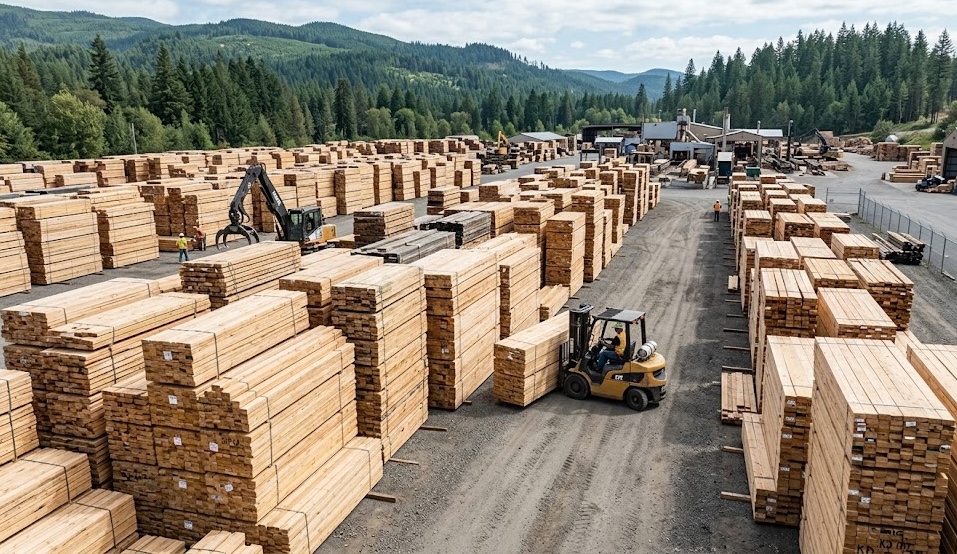
Understanding lumber grades is essential for selecting the right wood for your project. This guide covers hardwood grades, softwood grades, structural grades, and the special considerations that apply to reclaimed lumber.
Tell us about your project and we'll get back to you within one business day.
Lumber grades are a standardized way of communicating the quality, appearance, and structural properties of wood. They help buyers know exactly what they're getting and help sellers price their material fairly.
Different grading systems exist for hardwoods, softwoods, and structural timber. Each system evaluates different characteristics — knots, grain pattern, warp, splits, decay, and strength — and assigns a grade that indicates the wood's suitability for various applications.
The National Hardwood Lumber Association (NHLA) sets grading rules for North American hardwoods. Grades are based on the percentage of clear, defect-free wood in each board.
The highest standard grade. Boards must be at least 6" wide and 8' long with at least 83⅓% clear face area. Used for premium furniture, cabinetry, and architectural millwork.
One face meets FAS standards while the other meets #1 Common. A cost-effective choice when only one face is visible in the finished application.
Similar to F1F but minimum board size is 4" × 6'. Widely used for high-quality furniture and trim where only one face shows.
Good quality with small, tight knots allowed. At least 66⅔% clear face area. Used for quality furniture, paneling, and flooring.
Medium quality. At least 50% clear face area. Suitable for standard-grade furniture, kitchen cabinets, and molding stock.
Similar yield to #2A but smaller minimum board size. Used for smaller cuttings in flooring, paneling, and craft wood.
Economy grade. At least 33⅓% clear face area. Used for crating, pallet stock, and applications where appearance is secondary.
Softwood lumber (pine, fir, spruce, cedar) is graded differently. The Western Wood Products Association (WWPA) and Southern Pine Inspection Bureau (SPIB) are the primary grading authorities.
Highest structural grade. High strength values, limited knots. Used in engineered applications where maximum performance is required.
Strong structural grade with slightly more knots than Select. Used for general framing and structural applications.
The most common structural grade. Good strength with moderate knots. Standard framing, joists, rafters.
Lower structural grade with larger and more frequent knots. Used for non-load-bearing walls, bracing, and blocking.
Graded for looks, not strength. Includes C Select, D Select, and various finish grades for trim, siding, and paneling.
Specifically graded for vertical load-bearing in wall framing. Evaluated for straightness, strength, and stiffness.
Reclaimed lumber presents unique grading challenges. Standard NHLA and WWPA rules were developed for new lumber, and reclaimed wood has characteristics that don't fit neatly into these systems: nail holes, surface weathering, checking from age, and non-standard dimensions.
At Norfolk Lumber, we use a modified grading approach that combines elements of standard grading with practical assessments of reclaimed-specific factors:
Is the wood strong enough for its intended use? We assess grain density, decay, insect damage, and internal checking.
We de-nail all lumber, but residual holes remain. We grade the density and size of holes relative to the board's surface area.
Weathering, patina, saw marks, and oxidation. For rustic applications, these are features. For milled applications, we note how much material must be removed to reach clean wood.
We measure moisture content with a pin-type meter. Air-dried reclaimed wood typically reads 12-18%. Kiln-dried stock targets 6-8%.
We verify species identification through visual inspection and, when needed, microscopic analysis of end grain.
Understanding defects is the foundation of understanding grades. Every grading system is essentially a framework for describing and quantifying defects. Here are the most common defects you will encounter in both new and reclaimed lumber, along with how they affect grading decisions.
Knots are the remnants of branches embedded in the trunk wood. They are classified as tight (firmly attached), loose (can fall out), or missing (knot holes). Tight knots under 1/2 inch are generally acceptable even in higher grades. Loose knots and knot holes reduce the grade significantly because they weaken the board and create finishing challenges. In structural grading, knot size relative to board width directly determines the grade — a knot occupying more than one-quarter of the cross section drops the board to #2 or lower.
Checks are cracks along the grain that do not extend through the full thickness of the board. Splits extend completely through. Surface checks under 2 inches are common in air-dried lumber and have minimal impact on grade for appearance applications. End splits up to twice the board width are tolerated in lower grades. In structural lumber, checks and splits reduce shear strength and lower the grade proportionally to their length and depth. Reclaimed timbers frequently show checking from decades of moisture cycling, which is evaluated differently than checks in new lumber.
Wane is the presence of bark or the rounded outer surface of the log on the edge of a sawn board. It indicates the board was cut from the outer portion of the log. Wane reduces the usable rectangular cross-section and is penalized in both appearance and structural grades. In structural grading, wane is measured as a fraction of the face width and thickness it affects. In appearance grading, any visible wane typically drops the board below Select grade. Some designers specifically request wane-edge boards for a rustic, live-edge aesthetic.
Warp is any deviation from a flat plane. Bow is lengthwise curvature along the face — a board that rocks when placed face-down on a flat surface. Cup is curvature across the width, creating a channel shape. Twist is a spiral distortion where the board is not flat in any direction. Cup can often be corrected by resawing or planing. Bow can be pulled out during installation if the boards are properly fastened. Twist is the most problematic because it cannot be easily corrected. Severe warp of any type can drop a board by one or two grades.
Decay is caused by fungal organisms that break down wood fiber. Early-stage decay (incipient decay) causes discoloration but minimal strength loss. Advanced decay produces soft, punky wood that crumbles under pressure. Any advanced decay disqualifies lumber from structural grades entirely. In appearance grading, sound, firm decay (spalting) can actually increase the aesthetic value of the wood — spalted maple is highly prized by woodworkers. Norfolk Lumber inspects all reclaimed stock for decay and clearly identifies any boards with cosmetic spalting versus structural compromise.
Insect tunnels and exit holes reduce both structural integrity and appearance. Small, scattered pin holes (under 1/16 inch) from powder post beetles have minimal structural impact but lower the appearance grade. Larger tunnels from carpenter ants or old house borers can significantly reduce cross-sectional strength. In reclaimed lumber, insect damage is usually historical — the insects are long gone. "Wormy" character (especially wormy chestnut) is prized in rustic design and commands premium prices despite technically being a defect. We verify all insect damage is inactive before selling.
Staining includes blue stain (caused by fungi carried by bark beetles), mineral stain (dark streaks from mineral deposits in the soil), and oxidation. Blue stain does not affect strength but is a significant appearance defect that can drop boards below FAS or Select grades. Mineral stain is common in species like poplar and tulipwood. In reclaimed lumber, surface oxidation and patina are expected and often desired. We distinguish between surface patina (which can be planed off to reveal fresh wood below) and deep staining that penetrates throughout the board.
Pitch pockets are lens-shaped cavities between growth rings filled with liquid or dried resin. They are most common in softwood species like Douglas fir and pine. Small pitch pockets (under 2 inches long and 1/8 inch wide) are tolerated in most grades. Larger pockets lower the grade and can cause finishing problems — resin can bleed through paint and varnish. In reclaimed softwood, pitch is usually fully crystallized after decades of aging, which eliminates the bleeding problem. However, the cavities themselves remain and are evaluated as defects.
The right grade depends entirely on the end use. Specifying a higher grade than necessary wastes money; specifying too low risks structural failure or an unsatisfactory appearance. Here is our guidance for the most common applications.
For residential flooring, #1 Common provides an excellent balance of quality and value. It allows small, tight knots and minor character marks that add visual interest without compromising durability. If you want a clean, uniform look with minimal grain variation, specify FAS or Select. For rustic or character-grade floors that celebrate knots, nail holes, and surface texture, #2 Common reclaimed stock can produce stunning results at a lower cost. Regardless of grade, ensure your flooring stock is kiln-dried to 6-8% moisture content and milled to precise tongue-and-groove profiles with consistent thickness.
Furniture makers need large, clear cuttings with consistent color and grain. FAS grade provides the widest, longest boards with the fewest defects — critical when you need uninterrupted surfaces for tabletops, door panels, and drawer fronts. Select grade is a smart alternative when only one face needs to be clear, as in frame-and-panel construction where the back side is hidden. For reclaimed furniture, many makers specifically request #1 Common with character features like old nail holes and patina, which become design elements in the finished piece. Always hand-select boards for furniture — even within a grade, individual board character varies.
Structural applications are governed by building codes and require lumber graded to specific structural standards. Select Structural and #1 grade offer the highest allowable stress values. For reclaimed timber, structural grading evaluates the remaining sound cross-section after accounting for all defects — knots, checks, wane, and decay are measured and their combined effect on strength is calculated. A licensed structural engineer should specify the required grade and species for any load-bearing application. Norfolk Lumber provides grading certificates for all structural-grade reclaimed timbers, documenting the species, grade, and dimensions of each piece.
Accent walls and paneling are purely decorative, so structural strength is not a concern. This makes them an ideal application for lower-grade material that offers visual interest at a lower price point. Reclaimed barn wood siding, weathered shiplap, and mixed-species boards with varying patina create dramatic feature walls. For a cleaner, more refined look, #1 Common planed and profiled stock works beautifully. The key consideration for wall cladding is dimensional stability — use kiln-dried or well-acclimated material to prevent gaps from opening between boards as the wood adjusts to interior humidity levels.
Exterior applications demand species with natural rot resistance — white oak, cypress, cedar, or redwood. The grade should be #1 Common or better to ensure the boards have sufficient integrity to withstand weathering. Tight knots are acceptable but loose knots and large checks should be avoided as they create entry points for moisture. For decking, specify boards with vertical or quartersawn grain orientation, which minimizes cupping and provides a more stable walking surface. All exterior lumber should be treated with a UV-protective penetrating oil finish within 30 days of installation and refinished annually or as needed.
Mantels, floating shelves, and architectural details are focal points that draw the eye, so material selection is critical. For a refined, formal look, choose FAS or Select grade with uniform color and straight grain. For a rustic statement piece, a single character-grade timber with hand-hewn marks, weathering, and natural checking can be breathtaking. When selecting a mantel beam, look for a piece with a flat top surface for setting objects, a visually interesting front face, and consistent depth from end to end. We recommend sealing all surfaces — including the back and ends — with a penetrating finish to prevent moisture exchange and cracking after installation.
Moisture content (MC) is one of the most critical factors in lumber quality, yet it is often overlooked by buyers focused solely on species and grade. MC affects dimensional stability, structural strength, finishing performance, and susceptibility to decay. Understanding the relationship between moisture and grading will help you make better purchasing decisions and avoid costly installation failures.
Moisture content is expressed as a percentage of the water weight relative to the oven-dry weight of the wood. A board at 12% MC contains water equal to 12% of its bone-dry weight. Two measurement methods are standard: pin-type meters drive two metal pins into the wood and measure electrical resistance between them (more moisture means lower resistance); pinless meters use electromagnetic waves to measure MC without damaging the surface. Pin meters are more accurate for deep readings and for detecting moisture gradients through the board thickness. At Norfolk Lumber, we use calibrated pin-type meters and take readings at multiple points along each board to ensure consistent moisture levels throughout.
Wood is hygroscopic — it constantly absorbs and releases moisture in response to its environment. Equilibrium moisture content is the MC at which wood is neither gaining nor losing moisture in a given temperature and humidity environment. In most heated and air-conditioned interiors in the Mid-Atlantic region, EMC averages 6-9%. Unheated spaces, garages, and covered porches may have EMC of 12-14%. Outdoor, fully exposed wood stabilizes at 12-18% depending on the season. Lumber should be delivered as close to the job site's EMC as possible to minimize post-installation movement. Kiln-dried lumber at 6-8% MC is ideal for interior projects; air-dried lumber at 12-15% MC is appropriate for covered exterior or semi-conditioned spaces.
The allowable stress values published for structural lumber grades assume a specific moisture content — typically 19% or below for “dry” lumber (stamped S-DRY or KD) and above 19% for “green” lumber (stamped S-GRN). Green lumber has lower published strength values because water in the cell walls reduces the wood's compressive and bending strength. As green lumber dries below the fiber saturation point (approximately 28% MC), its strength increases significantly. A Douglas fir #2 stud at 15% MC is measurably stronger than the same stud at 25% MC. For structural applications, always specify dry lumber and verify moisture content on delivery — accepting green lumber for a job designed around dry stress values can result in undersized members and potential structural failure.
When evaluating lumber moisture, look beyond the meter reading. Check for visual clues: excessively heavy boards are often wetter than they should be, cupping and surface checking can indicate rapid drying, and a musty smell suggests elevated moisture and potential fungal activity. Test multiple boards in a delivery — not just the top or most accessible ones. Boards in the center of a tightly stacked bundle may read 2-4% higher than those on the outside. For flooring and millwork, reject any board over 9% MC for interior installation. For framing lumber, up to 19% is acceptable if the structure will be allowed to dry before enclosure. Always record your meter readings at time of delivery as documentation against future moisture-related claims.
If you work with imported lumber or are specifying material for international projects, it helps to understand how other countries grade their wood. While the principles are similar — evaluating defects and assigning quality tiers — the terminology and specific criteria differ.
European hardwood grading under EN 975 uses a lettered system: QF-1a (prime), QF-1b (select), QF-2 (standard), and QF-3 (rustic). These roughly correspond to North American FAS, Select, #1 Common, and #2 Common respectively. European softwood appearance grades under EN 1611 use a G0 through G4 system, where G0 is virtually defect-free and G4 allows significant knots and defects. European structural grading can be visual (similar to North American) or machine-graded (strength-tested), with machine grading being more common in Europe. C-class grades (C14, C16, C24, etc.) indicate the characteristic bending strength in Newtons per square millimeter.
Australia grades hardwood for structural use under AS 2082, with grades from A1 (select structural, minimal defects) down to Utility. Appearance grades under AS 2796 use a numbered system: Select Grade 0 (highest, essentially clear), Select Grade 1, Standard Grade, and Utility Grade. Australian grading accounts for unique local species characteristics, including the natural presence of gum veins (a common feature in eucalyptus species that is not considered a defect unless it is open or loose). The system also evaluates features like insect damage from local species such as Lyctus borers.
Japan uses the JAS grading system, which evaluates appearance, structural performance, and moisture content with particular rigor. Visual grades include First Grade, Second Grade, Third Grade, and Standard Grade. Japan also employs machine stress-rated (MSR) grading extensively, testing each piece of lumber individually for stiffness using calibrated machines. The Japanese system places exceptional emphasis on dimensional accuracy and moisture content consistency — tolerances are significantly tighter than North American standards. Japan also has specific grades for traditional post-and-beam construction (known as zairai koho) that evaluate straightness, surface quality, and precise dimensional compliance.
There is no perfect one-to-one mapping between grading systems, but general equivalencies can be established. North American FAS roughly corresponds to European QF-1a, Australian Select Grade 0, and Japanese First Grade. North American #1 Common maps approximately to European QF-2, Australian Select Grade 1, and Japanese Second Grade. For structural grades, the comparison is more complex because each system uses different species-specific strength values and safety factors. When specifying lumber for export or for projects designed under foreign building codes, consult the specific standard and work with a grader certified under that system. Norfolk Lumber can provide grading under North American standards and advise on approximate international equivalencies.
New lumber from commercial mills bears a grade stamp — an ink mark or brand applied by a certified grader. Understanding these stamps helps you verify that the lumber you receive matches what was ordered. Reclaimed lumber typically does not carry grade stamps (they were lost during salvage and remilling), which is why buying from a reputable dealer who grades in-house is essential.
The logo or abbreviation of the grading authority (e.g., WWPA, SPIB, NELMA, WCLIB). This identifies which organization's rules were applied and which organization certifies the mill's grading program. The grading agency is responsible for auditing the mill's graders periodically to ensure compliance with published standards.
A numeric or alphanumeric code identifying the specific sawmill that produced the lumber. This allows traceability — if a grade dispute arises, the mill number connects the material back to its source. Each mill is assigned a unique number by its grading agency.
The grade of the lumber (e.g., SEL STR, #1, #2, STUD, CONST). This is the core information in the stamp. For structural lumber, this grade determines the allowable stress values you can use in engineering calculations. For appearance lumber, it indicates the quality tier for aesthetic applications.
The species or species combination (e.g., DF-L for Douglas Fir-Larch, SPF for Spruce-Pine-Fir, SYP for Southern Yellow Pine). Species groups contain multiple species with similar mechanical properties that can be used interchangeably in structural calculations. The species designation determines which design value tables apply.
S-DRY means the lumber was surfaced at 19% MC or below. KD indicates kiln-dried, typically to 15% or below. MC15 means 15% MC or below. S-GRN means the lumber was surfaced green (above 19% MC). This information is critical for structural calculations and for predicting shrinkage — green lumber will shrink as it dries and may develop checks, gaps, and warp.
Some stamps include HT (heat treated to ISPM-15 standards for export compliance), KDAT (kiln-dried after treatment for preservative-treated lumber), or FSC (Forest Stewardship Council certified for sustainably harvested material). These additional marks provide information about processing and chain-of-custody certification.
When you place an order with us, specifying the right grade ensures you get material that meets your project requirements without paying for quality you do not need. Here is how to communicate your grading needs effectively.
Tell us what the wood will be used for — flooring, furniture, structural beams, wall cladding, exterior siding, or something else. The application determines whether appearance grading or structural grading applies, and it narrows the species and grade options immediately. A fireplace mantel has completely different requirements than a floor joist, even if both are reclaimed oak.
Are you looking for clean, uniform boards with minimal character marks? Or do you want the full rustic experience with nail holes, weathering, and natural imperfections? We use terms like “premium” (minimal defects, consistent color), “character” (moderate knots, old fastener holes, patina), and “rustic” (heavy character, mixed patina, natural edge variation). Sharing photos of projects you admire is the fastest way to communicate your aesthetic expectations. We will match our grading to your visual standard.
Specify the thickness, width, and lengths you need along with total board footage. If you can accept random widths and lengths (which is standard for reclaimed lumber), note that — it gives us more flexibility and can reduce your cost. If specific lengths are critical (for example, 10-foot minimum for a continuous floor run without end joints), state that clearly so we can grade and select accordingly. Include a 10-15% waste factor in your quantity calculation to account for cutting waste, defect removal, and job-site damage.
For any order over 500 board feet, we strongly recommend requesting samples before committing. We will send representative pieces that show the range of character within your specified grade — not just the best boards in the pile. This eliminates surprises when the full delivery arrives. Samples are available for a nominal fee that is credited toward your final order. For commercial projects, we can prepare approval panels showing the installed look with your specified profile and finish.
Our team helps you match the right grade to your application. Don't overspend on appearance grade when structural will do — and don't under-spec when quality matters.