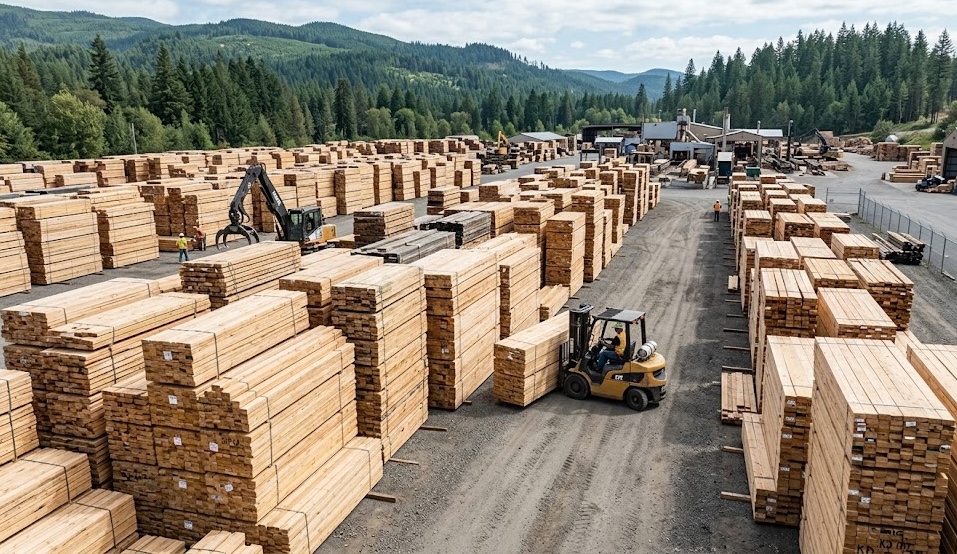
Character-rich wood with decades of history. Every board, beam, and plank in our inventory has been salvaged, sorted, graded, and prepared for its second life.
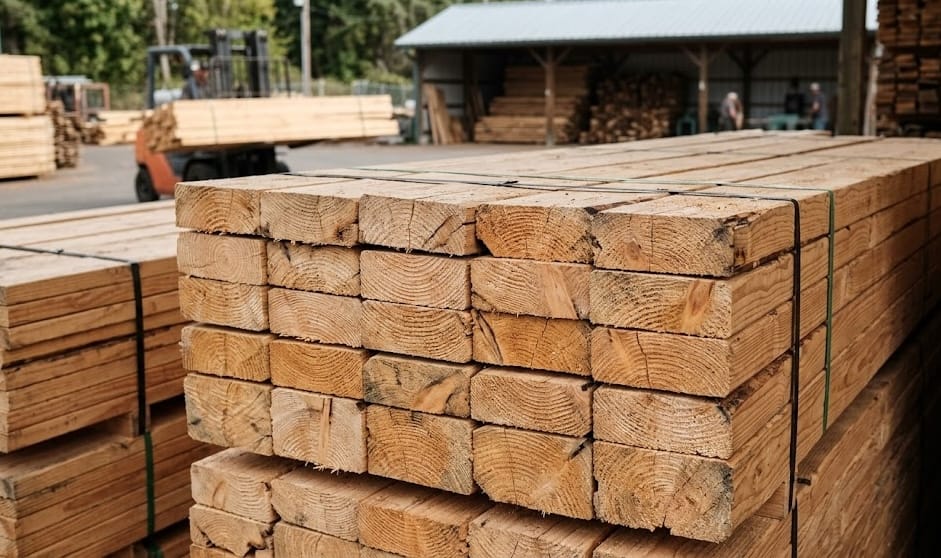
Tell us about your project and we'll get back to you within one business day.
Reclaimed lumber is wood that has been salvaged from existing structures — barns, warehouses, factories, bridges, and other buildings — before or during demolition. This wood was typically harvested from old-growth forests decades or even centuries ago, making it denser, more stable, and more visually striking than today's commercially grown timber.
At Norfolk Lumber, we maintain one of Virginia Beach's largest inventories of reclaimed wood. Each piece is inspected, de-nailed, graded, and sorted by species, dimension, and condition. Whether you need a single statement beam for a fireplace mantel or a truckload of reclaimed decking for a commercial project, we have the stock and the expertise.
Massive structural members salvaged from barns, warehouses, bridges, and industrial buildings. Available in oak, pine, Douglas fir, and mixed hardwoods. Typical dimensions range from 6×6 to 12×16, with lengths up to 24 feet.
Common uses: Fireplace mantels, exposed ceiling beams, pergolas, furniture, structural headers, decorative accents.
Flat stock ranging from ¾" to 2" thick, in widths from 4" to 14"+. Sourced from barn siding, warehouse flooring, factory decking, and demolition framing. Includes both rough-sawn and surfaced options.
Common uses: Accent walls, shelving, table tops, cabinetry, paneling, wainscoting, picture frames.
Tongue-and-groove and plain-edge reclaimed flooring in heart pine, white oak, chestnut, and mixed hardwoods. Pre-milled to standard flooring dimensions or custom widths.
Common uses: Residential and commercial flooring, stair treads, landings, and transitions.
Weathered barn wood, shiplap, and board-and-batten siding with authentic patina. Available in various widths and profiles, both interior and exterior rated.
Common uses: Feature walls, exterior cladding, ceiling treatments, restaurant and retail interiors.
Thick, dense reclaimed lumber suitable for outdoor decking applications. Primarily old-growth species with natural resistance to rot and insects.
Common uses: Residential decks, commercial patios, boardwalks, dock planking.
Southeast US warehouses and mills
Rich amber-to-red tones, tight grain, extremely dense. The gold standard of reclaimed softwood.
Barns and agricultural buildings
Silvery gray exterior, warm honey interior. Rot-resistant, ideal for furniture and flooring.
Industrial flooring and framing
Warm reddish-brown with prominent grain. Strong and versatile.
Pacific Northwest industrial structures
Straight grain, warm tones, exceptional strength-to-weight ratio. Outstanding for beams.
Pre-blight barns and structures
Rare, wormy, warm brown. No longer commercially available — reclaimed is the only source.
Various demolition and salvage sites
An assortment of species offering varied color and grain. Perfect for rustic and eclectic designs.
We source reclaimed lumber from demolition and salvage operations across three primary regions of the eastern United States. Each region produces wood with distinct species, character, and history.
Virginia, Maryland, Delaware, Pennsylvania, West Virginia
The Mid-Atlantic is our home territory and our richest source of reclaimed material. Virginia and Pennsylvania barns built between 1780 and 1900 yield exceptional white oak and chestnut timbers. Tobacco barns from the Virginia Piedmont feature wide heart pine boards with a deep amber patina developed over centuries of air curing. Industrial warehouses along the Chesapeake Bay corridor — particularly in Baltimore, Richmond, and Norfolk — provide massive Douglas fir and longleaf pine beams originally shipped from the Pacific Northwest and Southeast during the railroad expansion era. The humidity and temperature cycles of this region create a distinctive surface character: a silvery gray weathering on exterior surfaces and a warm, honey-toned interior where the wood was protected.
North Carolina, South Carolina, Georgia, Alabama, Tennessee
The Southeast is the heartland of longleaf pine and heart pine reclamation. Cotton mills, textile factories, and railroad trestles built during the Industrial Revolution used enormous quantities of old-growth longleaf pine — a species so dense it sinks in water. These structures, many now 100 to 150 years old, produce boards with 15 to 25 growth rings per inch, a density unmatched by any commercially grown softwood today. North Carolina tobacco barns contribute wide poplar and oak planks, while Georgia and Alabama sawmill towns yield cypress timbers with extraordinary rot resistance. Tennessee barn demolitions often uncover rare American chestnut, a species wiped out by blight in the early 1900s and now available only through reclamation.
New York, New Jersey, Connecticut, Massachusetts, Maine
New England and the greater Northeast offer some of the oldest reclaimed lumber in our inventory. Barns in upstate New York and Connecticut dating to the 1700s produce hand-hewn beams with visible adze marks and mortise-and-tenon joinery — original timber framing that predates the use of nails. Maine contributes old-growth eastern white pine boards up to 24 inches wide, cut from trees that were already centuries old when they were first milled. Factory buildings in the textile corridors of Massachusetts and New Jersey yield dense maple and birch flooring with a rich patina from a century of industrial foot traffic. The cold, dry winters of this region produce tight-grained wood with exceptional dimensional stability.
Unlike new lumber graded by standardized industry bodies, reclaimed lumber requires a hands-on, multi-step evaluation process. Here is exactly how every piece in our inventory is assessed before it reaches your project.
Every piece of reclaimed lumber entering our yard undergoes a thorough visual inspection. Our graders identify the wood species by examining grain pattern, color, end-grain pore structure, and density. Heart pine, white oak, chestnut, and Douglas fir each have distinctive characteristics that an experienced grader can identify on sight. We also assess the overall condition: checking for rot, insect damage, excessive checking, and structural compromise. Boards that fail initial inspection are set aside for secondary use or recycled — they never enter our retail inventory.
Reclaimed lumber almost always contains embedded metal — nails, screws, bolts, staples, and occasionally wire or fencing. We run every board through an industrial metal detector and then hand-extract all ferrous and non-ferrous fasteners. This step is critical for two reasons: hidden metal destroys saw blades during milling, and it poses a safety hazard during installation. Our de-nailing crew uses specialized pullers, pneumatic extractors, and magnets to remove every detectable piece of metal. After extraction, each board is re-scanned to confirm it is clean.
We test every batch of reclaimed lumber with pin-type and pinless moisture meters to establish baseline moisture content. Wood that has been stored outdoors or recently salvaged from a damp environment may read 18% to 25% MC or higher. Our target for interior applications is 6% to 8% MC, and for exterior applications 12% to 15% MC. Lumber above target is tagged and routed to our kiln for controlled drying. We do not sell lumber for interior use that exceeds 10% MC unless the customer specifically requests air-dried stock for a particular application.
After cleaning and testing, each board is measured for thickness, width, and length, then assigned a grade based on our internal grading scale. Grade A (Premium) stock has minimal defects, consistent color, and full usable dimensions — suitable for furniture, visible installations, and fine woodworking. Grade B (Character) stock has nail holes, minor checking, and color variation that add rustic appeal without compromising structural integrity. Grade C (Utility) stock has more significant character marks and is ideal for accent walls, barn doors, and projects where heavy distressing is desired. All grades are structurally sound.
Every graded piece receives an inventory tag recording species, grade, dimensions, moisture content, and source location. This tag stays with the lumber through storage, milling, and sale. We store our reclaimed inventory in covered, ventilated sheds organized by species and grade. Beams and timbers are stickered on concrete pads with proper air circulation. Flooring-grade stock is stored indoors at controlled humidity. This systematic approach means when you order heart pine flooring in Grade A, you know exactly what you are getting — and we can trace it back to the structure it came from.
Reclaimed lumber is priced per board foot and varies by species, grade, dimensions, and availability. The ranges below are approximate and reflect our typical inventory pricing. Custom milling, kiln drying, and delivery are additional.
| Species / Product | Grade A (Premium) | Grade B (Character) | Grade C (Utility) |
|---|---|---|---|
| Heart Pine (Boards & Planks) | $8.50 – $14.00 | $5.50 – $8.00 | $3.50 – $5.00 |
| Heart Pine (Flooring, T&G) | $12.00 – $18.00 | $8.00 – $11.50 | $5.50 – $7.50 |
| White Oak (Boards & Planks) | $7.00 – $12.00 | $4.50 – $6.50 | $3.00 – $4.00 |
| Red Oak (Boards & Planks) | $5.50 – $9.00 | $3.50 – $5.00 | $2.50 – $3.50 |
| American Chestnut | $14.00 – $22.00 | $9.00 – $13.00 | $6.00 – $8.50 |
| Douglas Fir (Beams) | $6.00 – $10.00 | $4.00 – $5.50 | $2.50 – $3.50 |
| Mixed Hardwoods | $4.50 – $7.00 | $3.00 – $4.50 | $2.00 – $3.00 |
| Cypress | $9.00 – $15.00 | $6.00 – $8.50 | $4.00 – $5.50 |
All prices per board foot. Prices subject to change based on market availability. Contact us for an exact quote on your specific project requirements.
Reclaimed lumber is incredibly versatile. Here are some of the most common projects our customers undertake, along with material recommendations and practical details.
A single reclaimed beam transforms any fireplace into a focal point. We recommend 6×8 or 8×10 beams in white oak or Douglas fir, cut to length and finished with a clear penetrating oil to preserve the natural patina. Most mantels require 4 to 6 linear feet of material. Our crew can chamfer edges, wire-brush the surface for enhanced texture, or plane one face smooth for a mixed-finish look.
Reclaimed barn wood accent walls are one of the most popular residential applications we see. A typical 8×10-foot wall requires approximately 80 square feet of material. We recommend ¾" to 1" thick boards in mixed widths (4" to 8") for visual interest. Heart pine, white oak, and mixed hardwood boards all work beautifully. Boards can be installed horizontally, vertically, or in a herringbone pattern.
Reclaimed heart pine and white oak flooring offers a warmth and character that new hardwood simply cannot replicate. Our flooring is milled to ¾" thickness with tongue-and-groove edges, available in widths from 3¼" to 7" and wider. Expect to order 10% to 15% overage for waste and fitting. We recommend professional installation over a plywood subfloor with construction adhesive and blind-nailing.
A single reclaimed plank 2" to 3" thick and 12" to 20" wide makes a stunning table top. For wider tables, we edge-joint and glue up multiple boards to achieve 36" to 42" widths. Heart pine, white oak, and chestnut are the most requested species for table projects. We can supply the raw material or mill it to finished dimensions with a smooth surface ready for final sanding and finishing.
Reclaimed timbers bring instant character to outdoor structures. A basic 12×12-foot pergola typically requires four 6×6 posts at 10 feet tall, two 6×8 beams at 14 feet for the headers, and eight to ten 4×6 rafters at 12 feet. We recommend Douglas fir or white oak for their natural outdoor durability. All exterior reclaimed lumber should be sealed with a UV-resistant penetrating finish.
Reclaimed barn doors have become a design staple in both residential and commercial spaces. A standard 36×84-inch barn door requires approximately 21 square feet of material. We use 1" thick boards in widths of 6" to 10", assembled with a Z-brace or crossbuck pattern on the back. Pair with a salvaged or modern sliding track system from our accessories department for a complete installation.
Floating shelves made from reclaimed lumber add warmth to kitchens, living rooms, and offices. We recommend 2" thick planks in widths of 8" to 12" for open shelving, cut to lengths of 36" to 72". Heart pine and white oak are ideal because their density supports heavy loads without sagging. Each shelf can be finished with a food-safe oil for kitchen use or a satin polyurethane for general applications.
Breweries, restaurants, coffee shops, and retail stores are some of our largest customers for reclaimed lumber. Applications include bar tops (3" thick white oak slabs), wall cladding (mixed barn wood), ceiling treatments (shiplap or V-joint paneling), and custom furniture. We supply material for 15 to 20 commercial fit-outs per year, with typical orders ranging from 500 to 3,000 board feet. We work directly with architects, designers, and general contractors.
Reclaimed heart pine and white oak make exceptional stair treads with a depth of character that new wood cannot match. We mill treads to standard dimensions — typically 1" to 1¼" thick, 10½" to 11½" deep, with a bullnose edge profile on the leading edge. Risers are milled from ¾" stock. A full staircase of 13 treads and risers requires approximately 40 to 50 board feet of material depending on stair width.
Reclaimed wood is remarkably durable — it has already survived decades or centuries of service. With proper care, your reclaimed wood installation will look beautiful for generations to come.
New installations of reclaimed wood should receive a protective finish within two weeks of installation. For interior applications, we recommend a penetrating oil finish (tung oil or Danish oil) applied in two to three coats with light sanding between coats. Oil finishes enhance the natural color and grain while allowing the wood to breathe. For high-traffic areas like flooring, a water-based polyurethane in satin sheen provides more durable protection — apply three coats minimum with a 220-grit sand between each coat.
Dust reclaimed wood surfaces weekly with a dry microfiber cloth. For deeper cleaning, use a damp (not wet) cloth with a pH-neutral wood cleaner. Avoid all-purpose household cleaners, ammonia-based products, and excessive water — these can strip finishes, raise the grain, and cause discoloration. For flooring, use felt pads under furniture legs and place mats at entryways to reduce grit that scratches the finish. Vacuum regularly with a hard-floor setting (no beater bar).
Reclaimed wood, like all wood, expands and contracts with changes in humidity. Maintain indoor relative humidity between 35% and 55% year-round to minimize movement. In winter, when heating systems dry the air, use a humidifier to prevent excessive shrinkage and gapping in flooring. In summer, air conditioning naturally moderates humidity. Wide-plank flooring (6" and wider) is particularly sensitive to humidity swings and may develop seasonal gaps of 1/16" to 1/8" — this is normal and expected.
Oil-finished surfaces can be refreshed by applying a single maintenance coat of oil every 12 to 24 months, depending on wear. Simply clean the surface, lightly abrade with 320-grit sandpaper or a Scotch-Brite pad, and apply a thin coat of the same oil originally used. Polyurethane-finished floors typically need full refinishing every 7 to 12 years: screen-sand the entire floor with a 120-grit screen, vacuum thoroughly, and apply two fresh coats of polyurethane. Spot repairs are possible for localized damage.
Reclaimed lumber used outdoors — decking, pergolas, siding — requires more frequent attention. Apply a UV-resistant penetrating oil or stain every 12 to 18 months to prevent graying and moisture damage. Power-wash annually at low pressure (under 1,500 PSI) to remove dirt and mildew, then allow 48 to 72 hours of dry weather before reapplying finish. Inspect annually for signs of rot, insect activity, or fastener corrosion, and address any issues promptly.
Understanding the differences between reclaimed and new lumber helps you choose the right material for each element of your project. Many of our customers use both.
| Feature | Reclaimed Lumber | New Lumber |
|---|---|---|
| Density (Old-Growth vs. Plantation) | Significantly denser due to old-growth origin; 15–25 growth rings per inch in heart pine | Less dense; plantation-grown pine averages 4–8 growth rings per inch |
| Dimensional Stability | Highly stable — wood has completed most of its movement over decades of service | More prone to warping, cupping, and twisting as it acclimates post-milling |
| Environmental Impact | Minimal — diverts waste from landfills, requires no new tree harvesting | Requires tree harvesting, transportation, and milling from raw logs |
| Consistency & Uniformity | Variable — each piece is unique in color, grain, nail holes, and character marks | Highly consistent in dimension, color, and appearance within each grade |
| Cost | Premium grades ($8–$22/bf) can exceed new lumber; utility grades ($2–$5/bf) are comparable | Generally predictable pricing: $3–$12/bf for most domestic hardwoods |
| Availability | Limited by salvage supply — specific species and dimensions may not always be in stock | Readily available in standard dimensions from commercial suppliers |
| Character & Aesthetics | Unmatched — patina, saw marks, nail holes, and weathering tell a visual story | Clean and uniform; character must be added through distressing techniques |
| Structural Certification | Requires individual inspection; not pre-graded by a standards body | Machine-graded and stamp-certified to NHLA, SPIB, or WWPA standards |
| Species Availability | Access to species no longer commercially harvested (chestnut, old-growth longleaf) | Limited to currently cultivated and harvested species |
| Lead Time | 3–14 business days depending on milling requirements | Usually in stock for standard dimensions; 1–3 day lead time typical |
Yes, in most cases. Old-growth reclaimed lumber is typically denser and harder than modern commercially grown timber. Heart pine, for example, rates approximately 1,225 on the Janka hardness scale, while modern southern yellow pine rates around 870. However, structural use requires individual assessment — each beam or timber must be inspected for rot, insect damage, hidden checks, and metal contamination. We grade all structural-candidate timbers and can provide documentation for building inspectors. For engineered applications, we recommend consulting a structural engineer who can evaluate specific pieces for your load requirements.
Our grading team identifies every piece by species before it enters inventory. We examine grain pattern, pore structure (using a hand lens on end grain), color, density, and weight. Heart pine has a distinctive tight grain with 12 to 25 rings per inch and an amber-to-red color. White oak has prominent medullary rays visible on quarter-sawn faces. Chestnut shows a coarse, ring-porous grain similar to oak but is lighter in weight. Douglas fir has a straight, even grain with a warm orange-brown tone. Every piece in our inventory is tagged with its species identification.
Some reclaimed lumber, particularly material from pre-1978 structures, may have traces of lead paint on the surface. We test all painted stock and either strip the paint in a controlled environment or clearly label it if traces remain on non-contact surfaces. Our standard de-nailing process removes surface coatings on contact areas. For applications involving food contact (cutting boards, countertops) or children's furniture, we recommend using only our Grade A stock that has been planed to remove all original surface material, exposing clean, uncontaminated wood beneath.
For standard inventory items — boards, planks, and common beam sizes in oak, pine, and fir — we can typically fulfill orders within 3 to 5 business days. Custom-milled orders (tongue-and-groove flooring, specific planing dimensions, resawn boards) require 7 to 14 business days depending on volume and complexity. Large commercial orders exceeding 1,000 board feet may require 2 to 4 weeks, especially if we need to source additional material from our salvage network. We always confirm estimated lead times at the time of order.
Absolutely. We encourage customers to visit our Virginia Beach yard to hand-select material, especially for feature pieces like mantels, table tops, and accent walls where individual board character matters. Our yard is open Monday through Friday from 7:30 AM to 4:30 PM and Saturday from 8:00 AM to 1:00 PM. We recommend calling ahead so a team member can have the relevant inventory accessible and ready for you to browse. Closed-toe shoes are required in the yard.
We deliver throughout Hampton Roads and the greater Virginia Beach area. Local delivery within 30 miles of our yard is a flat $75 for orders under 500 board feet and free for orders over 500 board feet. Regional delivery (30 to 100 miles) is quoted based on distance and load size, typically ranging from $150 to $400. We also ship nationally via flatbed freight for large orders — freight costs are quoted per project and typically run $1.50 to $3.00 per board foot depending on destination. All deliveries include off-loading at the curb; forklift placement is available for an additional fee if access allows.
Reclaimed lumber pricing varies widely by species, grade, and availability. As a general rule, Grade B reclaimed oak and pine is comparable in price to new premium hardwood — roughly $4 to $8 per board foot. Grade A premium reclaimed stock, especially rare species like American chestnut or wide-plank heart pine, commands a significant premium: $12 to $22 per board foot or more. However, many customers find that the character, density, and story behind reclaimed wood justify the investment, especially for visible, high-impact applications. For projects where budget is a concern, our Grade C utility stock offers authentic reclaimed character at $2 to $5 per board foot.
Our inventory changes constantly as new salvage arrives. If you don't see what you need, tell us — we likely have it in the yard or can source it for you.