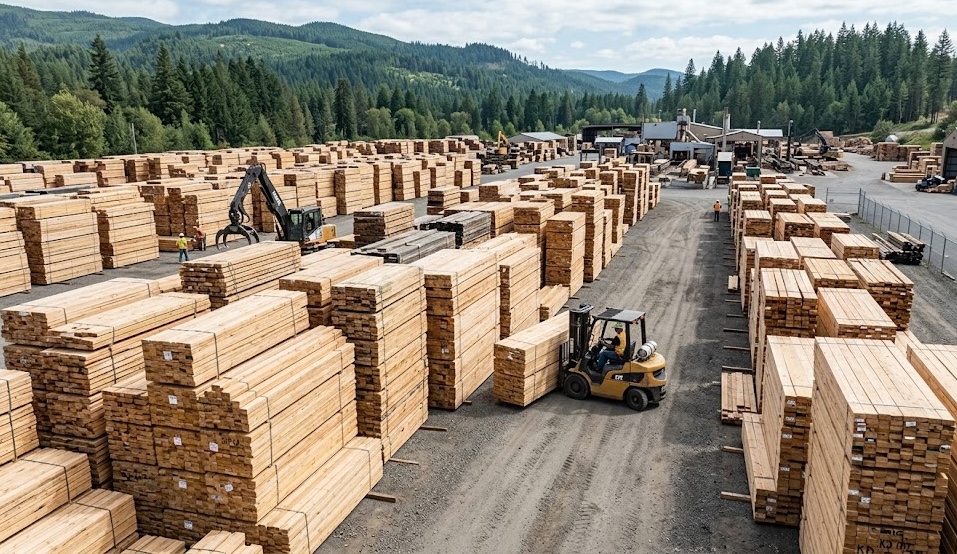
Every board foot of reclaimed lumber we process is a vote against clear-cutting, a strike against landfill waste, and an investment in the circular economy.
Tell us about your project and we'll get back to you within one business day.
The construction industry generates roughly 600 million tons of demolition waste annually in the United States. A significant portion of that waste is wood — structural lumber, sheathing, beams, joists, and finish materials that are perfectly functional but discarded because demolition is faster and cheaper than deconstruction.
Norfolk Lumber exists to challenge that calculation. We make it economically viable to salvage, sort, grade, and resell used lumber. We pay demolition crews and property owners for their wood. We process it into marketable products. And we connect it with buyers who understand that the most sustainable board is the one that already exists.
This isn't just recycling. It's upcycling — taking material that was headed for a landfill and turning it into a premium product with a story, a character, and a measurably lower carbon footprint than virgin lumber.
We divert thousands of tons of usable wood from landfills every year. Our goal is to reach 5 million board feet of annual reclamation by 2027.
Wood stores carbon for its entire lifespan. By keeping reclaimed lumber in use, we prevent that stored carbon from being released through decomposition or burning.
Every board of reclaimed wood sold is one less board cut from a living tree. We reduce pressure on forests and the ecosystems they support.
We buy local, process local, sell local. Our supply chain is measured in miles, not continents. This slashes transportation emissions and keeps money in the community.
Sawdust becomes animal bedding. Off-cuts become kindling or are chipped for mulch. Logs that can't be milled become firewood. Our waste stream is measured in gallons, not tons.
Our trucks are loaded to capacity on every run. We plan routes to minimize empty miles and consolidate pickups and deliveries within the same region.
Our yard operations run on rooftop solar. The mill, the kiln, the lighting, the office — all powered by the same sun that grew the trees in the first place.
When we apply finishes to reclaimed wood, we use low-VOC, water-based products. No toxic chemicals, no off-gassing, no harm to indoor air quality.
Inventory, invoicing, and communication are paperless. Our office doesn't even have a printer. If it can be digital, it is digital.
Every nail, bolt, bracket, and piece of hardware extracted from reclaimed lumber is sorted and recycled through a local scrap metal processor. In 2025 alone, we recovered and recycled over 3,200 pounds of ferrous metal — enough to manufacture approximately 1,600 new hammers. Zero metal goes to landfill.
Wood that cannot be sold as lumber, mulch, or animal bedding — pieces too small, too damaged, or from treated sources — goes to a regional biomass energy facility in Chesapeake. This material generates electricity through combustion, displacing fossil fuel generation. In 2025, we diverted 28 tons of otherwise unusable wood to biomass energy production.
The borders of our 2.5-acre yard are planted with native wildflower and pollinator species — including Virginia bluebell, purple coneflower, and goldenrod — maintained without pesticides. These plantings support local bee and butterfly populations and provide natural stormwater filtration for runoff from our lumber stacking areas.
We capture rainwater from our warehouse and mill roofs into a 5,000-gallon cistern system. This water is used for dust suppression in the yard during dry months and for cleaning equipment. We use zero municipal water for non-potable operations, saving an estimated 40,000 gallons of tap water per year.
For the remaining emissions we cannot eliminate — primarily from fuel consumed by our non-electric delivery vehicles — we purchase verified carbon offsets through the American Carbon Registry. In 2025, we offset 24 tons of CO₂, covering 100% of our residual fossil fuel emissions for the year.
Every board foot of reclaimed lumber you use instead of virgin lumber prevents measurable carbon emissions. Here is the math.
Virgin lumber production generates approximately 2.2 pounds of CO₂ per board foot when accounting for logging operations, sawmill energy, kiln drying, and transportation. Reclaimed lumber eliminates nearly all of these emissions.
A typical order of 1,000 board feet of reclaimed lumber prevents 1.1 tons of CO₂ — the equivalent of driving a car 2,700 miles or burning 550 pounds of coal. This factors in the small emissions from our sorting, milling, and local delivery.
Our reclamation process is not zero-emission. Sorting, milling, kiln drying, and delivery produce approximately 0.3 lbs of CO₂ per board foot — an 86% reduction compared to virgin lumber production at 2.2 lbs per board foot.
Living Room Accent Wall (200 BF)
440 lbs CO₂ saved
Equal to taking a car off the road for 2 weeks
Full Home Flooring (2,500 BF)
2.75 tons CO₂ saved
Equal to powering a home for 3.5 months
Restaurant Interior (5,000 BF)
5.5 tons CO₂ saved
Equal to eliminating 6 round-trip flights NY to LA
Commercial Timber Frame (15,000 BF)
16.5 tons CO₂ saved
Equal to 37,500 miles of average car driving
Traditional lumber follows a linear path: forest to mill to project to demolition to landfill. Reclaimed lumber operates in a closed loop, where the “end” of one building's life becomes the beginning of another's. Here is how the full lifecycle works.
The cycle begins with an existing structure — a 100-year-old tobacco warehouse, a decommissioned railroad bridge, a mid-century factory, or a Depression-era barn. Inside these buildings are timbers that were harvested from old-growth forests that no longer exist in commercial quantities. The wood has already been seasoned by decades of service, its carbon locked in place.
When a property owner, municipality, or developer schedules a building for demolition or major renovation, the clock starts. In a conventional demolition, hydraulic excavators crush the structure and everything inside — wood, metal, concrete — gets hauled to a landfill. In our model, we intervene before demolition begins, extracting reusable lumber through selective deconstruction.
Our salvage team carefully disassembles the structure, removing fasteners by hand, labeling timbers by species and location, and loading material onto flatbeds for transport to our yard. This process takes longer than mechanical demolition but recovers 60-85% of the structural lumber in usable condition. The remaining materials — metal, masonry, wiring — are sorted for recycling.
At our Virginia Beach yard, every piece is inspected for species, structural integrity, insect damage, and chemical treatment history. Sound lumber is graded, de-nailed, and sorted. Depending on the end use, it may be planed, resawn, tongue-and-grooved, sanded, or kiln-dried. The result is a premium building product that meets modern specifications while carrying the character of its original life.
The processed lumber goes to architects, builders, designers, and homeowners who install it in new construction, renovations, and custom projects. A beam that once held up a factory roof now spans a living room ceiling. Barn siding from 1920 becomes a restaurant accent wall. Warehouse flooring from 1940 becomes a family dining table. The wood continues to sequester carbon, perform structurally, and look beautiful for decades to come.
When the new project eventually reaches end of life — in 50, 80, or 100 years — the lumber can be reclaimed again. High-quality hardwood and old-growth timber can cycle through multiple lives, each time avoiding the need to harvest a new tree. This is the essence of the circular economy: keeping valuable materials in productive use for as long as physically possible.
Our environmental practices are backed by certifications from recognized organizations and partnerships with leading sustainability nonprofits.
Certified by the Virginia Department of Environmental Quality for meeting rigorous environmental performance standards across waste management, energy use, water conservation, and pollution prevention.
Active member of the U.S. Green Building Council, contributing reclaimed material data and case studies to LEED credit documentation for green building projects across the region.
While FSC certification applies primarily to new timber, we follow FSC Chain of Custody principles in our sourcing documentation, ensuring full traceability from source structure to customer delivery.
We purchase verified carbon offsets through the ACR to cover residual emissions from our delivery fleet, making our overall carbon footprint negative when accounting for sequestration in reclaimed inventory.
We fund native tree plantings through CBF's riparian buffer program — 50 trees per 10,000 board feet sold. Our partnership has funded 680 tree plantings across the Bay watershed since 2021.
We donate reclaimed lumber for affordable housing construction and supply seconds and off-cuts to Habitat ReStore locations for public resale, diverting additional material from landfills.
As an active BMRA member, we participate in industry standards development, best practices sharing, and advocacy for policies that incentivize deconstruction over demolition nationwide.
We work with local conservation districts to promote the use of reclaimed wood in agricultural structures, reducing the demand for pressure-treated lumber near waterways and farmland.
We publish our environmental performance data annually. Here are the headline numbers from the last three years, showing consistent growth in our impact.
| Metric | 2023 | 2024 | 2025 |
|---|---|---|---|
| Board Feet Reclaimed | 380,000 | 465,000 | 520,000 |
| Trees Preserved (est.) | 576 | 705 | 788 |
| CO₂ Prevented (tons) | 209 | 256 | 286 |
| Landfill Diversion Rate | 95.8% | 96.7% | 97.3% |
| Salvage Partners Active | 34 | 38 | 42 |
| Solar Energy Generated (kWh) | 89,400 | 94,200 | 96,800 |
| Grid Electricity Purchased | 6,200 kWh | 4,100 kWh | 3,100 kWh |
| Metal Recycled (lbs) | 2,400 | 2,850 | 3,200 |
| Water Saved vs. Virgin (gal) | 2,052,000 | 2,511,000 | 2,808,000 |
| Delivery Miles Driven | 48,200 | 52,100 | 54,800 |
| Electric Vehicle Miles | 0 | 8,400 | 22,600 |
| Carbon Offsets Purchased (tons) | 18 | 22 | 24 |
Data covers calendar year January 1 through December 31 for each year. CO₂ prevention estimates use USDA Forest Products Laboratory emission factors. Tree preservation calculated at 660 board feet per mature tree.
Specifying reclaimed wood helps your project earn credits and points under the most respected green building certification programs.
MR Credit: Building Product Disclosure and Optimization — Sourcing of Raw Materials
Reclaimed lumber directly contributes to LEED Material and Resources credits. Using salvaged wood earns points under the Sourcing of Raw Materials credit (up to 2 points) by demonstrating that materials are extracted or sourced responsibly. Additionally, reclaimed wood contributes to the Construction and Demolition Waste Management credit by diverting material from landfills. Projects using reclaimed lumber can document these contributions through our chain-of-custody records and species certification.
Materials Petal — Imperative 13: Responsible Sourcing
The Living Building Challenge is the world's most rigorous green building standard. Its Materials Petal requires that all wood be FSC-certified or reclaimed — making our product a direct compliance pathway. LBC projects using our reclaimed lumber can document provenance through our chain-of-custody records, species identification, and chemical treatment history. We have supplied reclaimed materials for two LBC-pursuing projects in the Mid-Atlantic region.
Materials Concept — Feature M02: Material Restrictions
The WELL standard focuses on occupant health. Reclaimed wood treated with our water-based, low-VOC finishes meets WELL requirements for reduced off-gassing and improved indoor air quality. Additionally, the biophilic design benefits of natural wood surfaces contribute to WELL credits under the Mind concept (Feature M02: Biophilia I — Nature and Place). Reclaimed wood brings warmth, texture, and connection to natural materials that positively impact occupant well-being.
NAHB National Green Building Standard (ICC 700)
Reclaimed lumber earns points under the Resource Efficiency chapter for salvaged materials use, with additional credit for locally sourced materials within 500 miles.
Green Globes
Reclaimed wood contributes to the Resources assessment area, earning credit for materials with recycled content and reduced environmental impact.
ENERGY STAR for Commercial Buildings
While primarily energy-focused, the embodied energy savings of reclaimed lumber support the broader energy reduction narrative in ENERGY STAR documentation.
Passive House (PHIUS / PHI)
Reclaimed dense hardwoods offer superior thermal mass properties compared to modern plantation lumber, contributing to the thermal performance goals of Passive House designs.
When you buy from Norfolk Lumber, you're not just buying wood — you're investing in a system that keeps resources in circulation, reduces waste, and proves that sustainable building can be beautiful.