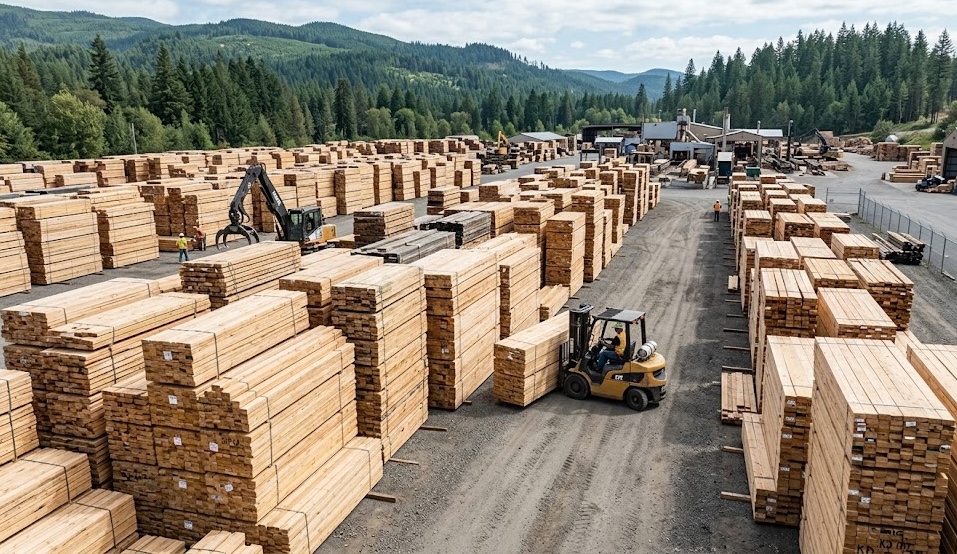
Everything you need to know about lumber dimensions, grades, and measurement standards — for both reclaimed and new wood.
Tell us about your project and we'll get back to you within one business day.
The nominal-to-actual dimension charts below apply to modern milled lumber. Reclaimed lumber often has different actual dimensions because older milling standards were less standardized. A reclaimed “2×4” might actually measure closer to 2” × 4” (true dimension) rather than the modern 1½” × 3½”. Always verify actual measurements before ordering reclaimed stock for tight-tolerance applications.
Lumber is sold by “nominal” size — the rough-cut dimension before drying and planing. The actual finished size is smaller. This table shows both.
| Nominal Size | Actual Size (in) | Metric (mm) |
|---|---|---|
| 1 × 2 | ¾" × 1½" | 19 × 38 mm |
| 1 × 3 | ¾" × 2½" | 19 × 64 mm |
| 1 × 4 | ¾" × 3½" | 19 × 89 mm |
| 1 × 6 | ¾" × 5½" | 19 × 140 mm |
| 1 × 8 | ¾" × 7¼" | 19 × 184 mm |
| 1 × 10 | ¾" × 9¼" | 19 × 235 mm |
| 1 × 12 | ¾" × 11¼" | 19 × 286 mm |
| 2 × 2 | 1½" × 1½" | 38 × 38 mm |
| 2 × 4 | 1½" × 3½" | 38 × 89 mm |
| 2 × 6 | 1½" × 5½" | 38 × 140 mm |
| 2 × 8 | 1½" × 7¼" | 38 × 184 mm |
| 2 × 10 | 1½" × 9¼" | 38 × 235 mm |
| 2 × 12 | 1½" × 11¼" | 38 × 286 mm |
| 4 × 4 | 3½" × 3½" | 89 × 89 mm |
| 4 × 6 | 3½" × 5½" | 89 × 140 mm |
| 6 × 6 | 5½" × 5½" | 140 × 140 mm |
| 6 × 8 | 5½" × 7½" | 140 × 190 mm |
| 8 × 8 | 7½" × 7½" | 190 × 190 mm |
Heavy timbers (5”+ in smallest dimension) are commonly available in reclaimed stock. These are among our most popular products.
| Size (Nominal) | Common Applications |
|---|---|
| 6 × 6 | Posts, porch columns, structural supports |
| 6 × 8 | Beams, headers, lintels |
| 6 × 10 | Floor joists, ridge beams |
| 6 × 12 | Main beams, load-bearing headers |
| 8 × 8 | Heavy posts, timber frame corners |
| 8 × 10 | Major beams, bents |
| 8 × 12 | Primary structural beams |
| 10 × 10 | Timber frame posts, large structural elements |
| 12 × 12 | Bridge timbers, heavy structural beams |
| 12 × 16 | Large span beams, industrial structures |
Deck boards are available in several standard sizes. The table below shows nominal and actual dimensions along with maximum joist spacing for each size. Reclaimed decking is typically 2× stock (thicker and more durable than standard 5/4 deck boards).
| Nominal Size | Actual Size | Max Joist Spacing | Notes |
|---|---|---|---|
| 5/4 × 6 | 1" × 5-1/2" | 16" on center | Standard residential deck board. Most popular size. |
| 2 × 6 | 1-1/2" × 5-1/2" | 24" on center | Heavy-duty residential and light commercial decking. |
| 2 × 4 | 1-1/2" × 3-1/2" | 16" on center | Narrow deck boards for decorative patterns, borders. |
| 2 × 8 | 1-1/2" × 7-1/4" | 24" on center | Wide-plank decking for docks, commercial patios. |
| 1 × 6 (T&G) | 3/4" × 5-1/2" | 16" on center | Tongue-and-groove porch flooring. Must be supported. |
Maximum recommended joist spacing for deck boards laid perpendicular or at a 45-degree diagonal to the joists. All values assume properly supported joists and fastened boards.
| Board Size & Species | Perpendicular | 45° Diagonal | Notes |
|---|---|---|---|
| 5/4 × 6 (SYP #2) | 16" | 12" | Standard residential. Perpendicular to joists. |
| 5/4 × 6 (Cedar/Redwood) | 16" | 12" | Softer species — do not exceed 16" OC. |
| 2 × 6 (SYP #2) | 24" | 16" | Allows wider joist spacing. Preferred for reclaimed. |
| 2 × 6 (Douglas Fir #2) | 24" | 16" | Strong and stable. Common reclaimed species. |
| 2 × 6 (White Oak) | 24" | 16" | Excellent for reclaimed decking. Naturally rot-resistant. |
| 2 × 8 (SYP #2) | 24" | 24" | Commercial and heavy-duty. Dock and pier decking. |
This table provides approximate maximum spans for solid-sawn beams supporting a single floor or roof system. Values assume Douglas Fir #2 or better grade, a 40 psf live load, and 10 psf dead load for floor applications.
Important: These are general guidelines only. Always consult a licensed structural engineer for load-bearing beam sizing in your specific application.
| Beam Size | Max Span (1-Story) | Max Span (2-Story) | Species / Grade |
|---|---|---|---|
| 4 × 6 | 6 ft | 4 ft | Douglas Fir #2 or better |
| 4 × 8 | 8 ft | 5 ft | Douglas Fir #2 or better |
| 4 × 10 | 10 ft | 7 ft | Douglas Fir #2 or better |
| 4 × 12 | 12 ft | 8 ft | Douglas Fir #2 or better |
| 6 × 8 | 10 ft | 7 ft | Douglas Fir #2 or better |
| 6 × 10 | 13 ft | 9 ft | Douglas Fir #2 or better |
| 6 × 12 | 15 ft | 11 ft | Douglas Fir #2 or better |
| 8 × 8 | 12 ft | 8 ft | Douglas Fir #2 or better |
| 8 × 10 | 15 ft | 10 ft | Douglas Fir #2 or better |
| 8 × 12 | 18 ft | 12 ft | Douglas Fir #2 or better |
| 10 × 10 | 17 ft | 12 ft | Douglas Fir #2 or better |
| 10 × 12 | 20 ft | 14 ft | Douglas Fir #2 or better |
| 12 × 12 | 22 ft | 16 ft | Douglas Fir #2 or better |
A board foot is the standard unit of measurement for lumber volume. One board foot equals a piece of wood 12 inches long × 12 inches wide × 1 inch thick (144 cubic inches).
Board Feet Formula
BF = (Thickness × Width × Length) ÷ 144
Where thickness and width are in inches, and length is in inches. Or: (T” × W” × L') ÷ 12 when length is in feet.
Knowing the weight of your lumber is essential for structural calculations, delivery planning, and equipment requirements. The table below lists approximate weights per board foot for common species at both green (freshly cut) and air-dried (12% MC) conditions, along with oven-dry density and Janka hardness.
| Species | Green (lb/BF) | Air-Dried (lb/BF) | Density (12% MC) | Janka Hardness |
|---|---|---|---|---|
| Heart Pine (Old-Growth Longleaf) | 4.6 | 3.6 | 38 lb/ft³ | 1,225 lbf |
| Southern Yellow Pine (New) | 4.3 | 3.1 | 35 lb/ft³ | 870 lbf |
| Douglas Fir | 3.8 | 2.8 | 32 lb/ft³ | 660 lbf |
| White Oak | 5.4 | 3.9 | 47 lb/ft³ | 1,360 lbf |
| Red Oak | 5.1 | 3.6 | 44 lb/ft³ | 1,290 lbf |
| American Chestnut | 3.9 | 2.6 | 30 lb/ft³ | 540 lbf |
| Eastern White Pine | 3.2 | 2.1 | 25 lb/ft³ | 380 lbf |
| Cedar (Western Red) | 2.8 | 1.9 | 23 lb/ft³ | 350 lbf |
| Cypress (Bald) | 4.0 | 2.8 | 32 lb/ft³ | 510 lbf |
| Walnut (Black) | 4.6 | 3.2 | 38 lb/ft³ | 1,010 lbf |
| Poplar (Yellow) | 3.5 | 2.4 | 29 lb/ft³ | 540 lbf |
| Maple (Hard) | 5.0 | 3.6 | 44 lb/ft³ | 1,450 lbf |
Weights are approximate and vary with actual moisture content, growth conditions, and grain density. Old-growth reclaimed wood is typically 10% to 20% denser than the same species grown commercially today.
Wood is hygroscopic — it absorbs and releases moisture in response to its environment. Installing wood at the correct moisture content for its intended application is the single most important factor in preventing post-installation problems.
| Application | Target MC | Reason | Tolerance |
|---|---|---|---|
| Interior Flooring | 6% – 8% | Must match the equilibrium moisture content (EMC) of a heated/cooled interior space to prevent gapping, cupping, and buckling. Flooring installed above 10% MC will shrink and develop gaps as it dries. | ±2% of subfloor MC |
| Interior Trim & Millwork | 6% – 8% | Trim and moldings are typically thin sections that respond quickly to humidity changes. Starting at low MC minimizes post-installation movement, joint opening, and paint cracking. | ±2% of ambient MC |
| Interior Furniture | 6% – 8% | Furniture wood must be very stable. Table tops, doors, and panel assemblies at higher MC will warp and joints will open as the wood dries in the conditioned interior environment. | ±1% for fine furniture |
| Cabinetry & Built-Ins | 6% – 9% | Cabinet doors and face frames need tight tolerances to maintain alignment. Excess moisture causes doors to bind in summer and gap in winter. Plywood cases are more stable but face frames must be low MC. | ±2% of ambient MC |
| Interior Wall Paneling | 8% – 10% | Wall paneling has slightly more tolerance for movement than flooring because installation methods (nailing, clips) allow for seasonal expansion. Slightly higher starting MC is acceptable. | ±3% of ambient MC |
| Exterior Siding & Trim | 12% – 15% | Exterior wood will stabilize at the local EMC, which varies from 12% to 19% depending on climate. Starting too dry causes initial swelling and buckling as the wood absorbs outdoor moisture. | Must not exceed 19% |
| Exterior Decking | 12% – 18% | Deck boards are exposed to direct weather and will cycle between 10% and 20% MC seasonally. Installing at 12% to 18% minimizes initial movement. Allow 1/8" gap between boards for expansion. | Seasonal range 10% – 20% |
| Timber Framing (Interior) | 12% – 15% | Large timbers dry very slowly — a 12×12 beam may take years to reach interior EMC. Starting at 12% to 15% is acceptable for structural timbers that will continue to dry in place. | ±4% of target |
| Timber Framing (Exterior) | 15% – 19% | Exterior structural timbers will stabilize at outdoor EMC. Very dry timbers installed outdoors will absorb moisture and swell, potentially stressing connections. Green timber (>19%) is acceptable for some applications. | Must not exceed 25% |
Lumber is measured in board feet, but your project might need square feet (for flooring and paneling), linear feet (for trim and framing), or cubic feet (for shipping and weight calculations). Here is how to convert between the common units.
Square Feet = Board Feet ÷ (Thickness in inches ÷ 12) ... simplified: for 1-inch boards, 1 BF = 1 SF
This assumes full-width coverage with no waste. For T&G flooring, add 5% for tongue waste and 10% to 15% for cutting waste.
Linear Feet = (Board Feet × 12) ÷ (Thickness in inches × Width in inches)
Use nominal dimensions for board foot calculations (industry standard). Actual coverage will be slightly less due to actual vs. nominal size difference.
Cubic Feet = Board Feet ÷ 12
This is the simplest conversion. One board foot = 1/12 of a cubic foot (144 cubic inches ÷ 1,728 cubic inches per cubic foot).
Board Feet = Square Feet × (Thickness in inches) × Waste Factor
Always add a waste factor: 10% for straight runs, 15% for rooms with many cuts, 20% for diagonal or herringbone patterns.
Beyond standard sizes, our milling operation and reclaimed inventory give us the ability to produce lumber in dimensions that big-box stores and standard suppliers simply cannot offer.
Old-growth timber from pre-industrial sawmills was cut from massive trees that produced boards far wider than anything available today. We regularly stock reclaimed boards 12 to 16 inches wide, and occasionally source material up to 24 inches. These ultra-wide planks are prized for table tops, counters, and feature shelving. Species commonly available in wide widths include heart pine, white oak, eastern white pine, and poplar.
Industrial structures, railroad bridges, and large agricultural buildings produced timbers far longer than standard modern supply. We carry reclaimed beams up to 30 feet and occasionally longer in Douglas fir and white oak. These extra-long timbers are essential for open-span construction, post-and-beam frames, and large pergolas where a single continuous member is required. Delivery of timbers over 20 feet requires a flatbed truck.
Standard lumber thicknesses are 4/4 (1 inch), 5/4 (1-1/4 inch), 6/4 (1-1/2 inch), 8/4 (2 inches), and so on. Many projects require non-standard thicknesses: 3/8-inch for veneer-weight wall cladding, 3/4-inch for T&G flooring, 1-3/4 inch for commercial table tops, or 5-inch slabs for live-edge waterfall counters. Our planer and band saw can produce any thickness from 3/16 inch to the full dimension of the source timber.
Quartersawn lumber (growth rings at 60 to 90 degrees to the face) and riftsawn lumber (30 to 60 degrees) offer superior dimensional stability, straight grain lines, and distinctive figure (medullary ray fleck in oak, vertical grain in fir). We hand-select quartersawn boards from our reclaimed inventory and can resaw larger timbers to produce quartersawn stock. Quartersawn white oak is particularly prized for Arts & Crafts and Mission-style furniture.
Small trim pieces, splines, plugs, inlay strips, and thin slats require precision milling at small dimensions. We can produce stock as narrow as 1/2 inch and as thin as 3/16 inch in lengths up to 8 feet. Common applications include edge banding, gap fillers, spline keys for mitered joints, and decorative inlay strips. These micro-dimension pieces are typically milled from offcuts, maximizing material yield from every board.
Lumber grades indicate the quality, appearance, and structural properties of the wood. Here's a quick overview of common grading standards.
Highest quality. Minimal knots, consistent grain, excellent appearance. Ideal for fine furniture, visible installations, and premium finishes.
High quality with small, tight knots. Sound wood suitable for high-grade shelving, paneling, and cabinet faces.
Medium quality with larger knots and some character marks. Great for general construction, shelving, and rustic applications.
Utility grade with knots, some defects, and character. Best for rough construction, crating, and applications where appearance is secondary.
Graded for strength, not appearance. Meets engineering standards for load-bearing applications. May have visible defects that don't affect structural integrity.
For a detailed guide to lumber grading, see our comprehensive grading guide.
Understanding the organizations that set lumber grading and measurement standards helps you communicate effectively with suppliers, contractors, and building inspectors. Here are the key industry bodies and what they do.
Hardwood lumber grading
The NHLA establishes and maintains the standard rules for grading North American hardwood lumber. Founded in 1898, the NHLA grading system is based on the percentage of clear (defect-free) cuttings that can be obtained from a board. The highest grade, FAS (Firsts and Seconds), requires at least 83-1/3% clear face area. The grades descend through Select, #1 Common (66-2/3% clear), #2A Common (50% clear), #2B Common (50% clear, smaller board size accepted), and #3 Common (33-1/3% clear). NHLA grades are the standard for pricing and trading hardwood lumber throughout North America. When ordering hardwood from Norfolk Lumber, specifying the NHLA grade ensures you get the quality level your project requires.
Softwood lumber grading (western species)
The WWPA grades and certifies softwood lumber species grown in the 12 western states, including Douglas fir, western red cedar, ponderosa pine, and hemlock. WWPA-stamped lumber carries a grade mark indicating species, grade, moisture content, and the mill of origin. Common WWPA grades for structural lumber include Select Structural, #1, #2, and #3, with the grade determined by the size and type of knots, grain slope, and other natural characteristics that affect strength. For appearance applications, WWPA grades include C Select, D Select, and various finish grades. WWPA grading rules are recognized by all major building codes in the United States.
Southern pine grading and inspection
The SPIB is the grading and certification authority for southern yellow pine (SYP), the most widely used structural softwood in the southeastern United States. SPIB-stamped lumber carries a grade mark that certifies the wood meets specific strength and quality standards. For structural use, the most common grades are #1, #2, and #3, with #2 being the standard grade for residential framing. SPIB also grades SYP for appearance, pressure treatment suitability, and machine stress-rating (MSR). Because southern yellow pine is the primary new softwood species we stock, most of our structural inventory carries a SPIB grade stamp.
Plywood, OSB, and engineered wood products
APA — formerly the American Plywood Association — develops standards, tests, and certifies engineered wood products including structural plywood, oriented strand board (OSB), glued laminated timber (glulam), cross-laminated timber (CLT), I-joists, and laminated veneer lumber (LVL). APA performance-rated panels carry a stamp indicating the span rating (e.g., 32/16 means the panel can span 32 inches when used for roof sheathing and 16 inches for floor sheathing), exposure durability, and structural capacity. While engineered wood products are outside our core reclaimed lumber focus, we stock structural plywood and can source APA-certified engineered products for projects that require them.
Overall softwood lumber standards
The ALSC oversees the American Softwood Lumber Standard (PS 20), which establishes the national standard for softwood lumber sizes, grade requirements, and inspection protocols. PS 20 is the document that defines nominal versus actual dimensions — the reason a 2×4 actually measures 1-1/2 by 3-1/2 inches. The ALSC also accredits the regional grading agencies (SPIB, WWPA, NLGA, WCLIB, and others) that inspect and stamp lumber at the mill. When a building code references "lumber graded in accordance with ALSC/PS 20," it means any lumber carrying a grade stamp from an ALSC-accredited agency is accepted.
New lumber is typically sold in even-foot increments. Reclaimed lumber lengths vary based on the original structure, but we sort and stock common lengths.
Custom lengths available through our milling service. Reclaimed beams and timbers available up to 30+ feet in some species.
Our team can help you determine the right dimensions, species, and grade for your specific project. Don't guess — ask the experts.