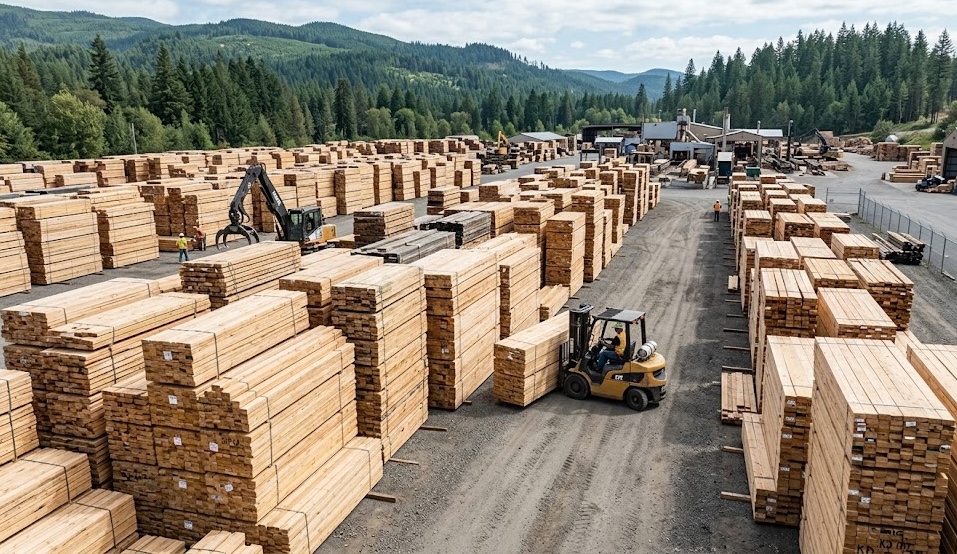
Lumber grading can feel arcane, but it directly affects the cost, appearance, and performance of every board you buy. This guide breaks the system down so you can order with confidence.
Tell us about your project and we'll get back to you within one business day.
Every piece of lumber that leaves a sawmill varies in strength, appearance, and the number of natural defects it contains. Grading systems were developed to create a common language between producers, distributors, and end users so that everyone knows what to expect from a given board without needing to inspect it personally. When you order "FAS White Oak" or "#2 Southern Yellow Pine," the grade tells the supplier exactly how much clear wood, what size boards, and what structural characteristics are acceptable.
Understanding these grades means you stop overpaying for material that exceeds your needs and stop under-specifying material that will fail in service. A rustic accent wall does not require FAS-grade hardwood, and a structural ridge beam should never be built from utility-grade softwood. The grade is the bridge between your project requirements and the lumber you actually purchase.
Two organizations dominate lumber grading in North America: the National Hardwood Lumber Association (NHLA) for hardwoods and the Western Wood Products Association (WWPA) for softwoods. Reclaimed lumber adds a third dimension because salvaged wood carries characteristics — nail holes, patina, checking — that standard grading rules were never designed to evaluate.
The NHLA system has been the standard for North American hardwood lumber since 1898. Grades are determined by calculating the percentage of clear (defect-free) cuttings that can be obtained from each board. The higher the grade, the larger and more numerous the clear pieces you can extract.
The premium standard. Boards must be at least 6 inches wide and 8 feet long. A minimum of 83-1/3 percent of the board surface must yield clear-face cuttings. FAS is specified for fine furniture, architectural millwork, and high-end cabinetry where large, unblemished panels are needed.
One face meets FAS requirements while the reverse face only needs to meet #1 Common. This grade is ideal when only one side of the board will be visible, such as paneling or drawer fronts. It typically costs 10-15 percent less than full FAS.
Similar to F1F but allows smaller boards (minimum 4 inches wide by 6 feet long). Popular for furniture makers who work with narrower stock and can use shorter pieces efficiently.
The workhorse grade. At least two-thirds of the board yields clear cuttings. Small, tight knots are typical. Widely used for quality furniture, hardwood flooring, and interior trim. Many professional woodworkers prefer #1 Common because the occasional character mark adds visual interest without compromising the piece.
A medium-quality grade yielding at least 50 percent clear cuttings. Boards will have more and larger knots than #1 Common. Suitable for standard kitchen cabinets, moulding stock, and painted or stained applications where minor defects are acceptable.
Economy grade. At least one-third of the board yields clear cuttings. Best suited for crating, pallet stock, rustic projects, and any application where appearance is secondary to function.
Softwood grading focuses on structural performance rather than appearance. The WWPA and the Southern Pine Inspection Bureau (SPIB) assign grades based on the size, frequency, and location of knots; the slope of grain; and the presence of wane, warp, or splits. These grades directly determine the allowable design values (bending strength, compression, shear) engineers use in calculations.
The highest structural grade. Tight knots only, straight grain, minimal wane. Specified when maximum strength and stiffness are required, such as headers, beams, and engineered trusses.
Strong grade with slightly larger knots than Select Structural. Used for general framing, rafters, joists, and posts. Allowable design values are roughly 80-85 percent of Select Structural.
The most widely used framing grade in residential construction. Moderate knots and some wane permitted. Suitable for studs, plates, joists, and blocking. Represents an excellent balance of cost and strength.
Lower structural grade with larger knots and more permitted defects. Appropriate for non-load-bearing partitions, temporary bracing, sheathing, and backing.
Graded specifically for vertical load-bearing in wall framing. Evaluated for straightness, strength under axial load, and stiffness. Available in lengths up to 10 feet.
Graded for visual quality rather than strength. C Select has minimal defects; D Select allows small, tight knots. Used for interior trim, siding, paneling, and shelving where looks matter most.
For a detailed breakdown of dimensions and board-foot calculations, see our Size Guide.
Standard grading rules were written for freshly sawn lumber. Reclaimed wood carries decades or centuries of history — nail holes, surface oxidation, checking from repeated moisture cycles, and sometimes non-standard dimensions from hand-hewn or circular-sawn origins. Applying NHLA or WWPA rules directly would downgrade virtually all reclaimed stock to the lowest tier, which does not reflect its actual quality or usable yield.
Reputable reclaimed lumber dealers use a modified grading approach. At Norfolk Lumber, we evaluate five factors that together give buyers a reliable picture of each board's condition and suitability:
We assess grain density, the presence or absence of decay, insect galleries, internal checks, and ring shake. Old-growth reclaimed lumber is frequently denser and stronger than modern plantation stock of the same species.
All boards are de-nailed and passed through a metal detector. Residual holes are graded by size and density per square foot. Boards with minimal holes grade higher; boards with heavy nail patterns are designated for rustic or painted applications.
Patina, saw marks, weathering, and original tool marks are documented. For barn-wood and accent-wall projects, heavy character is desirable and priced accordingly. For milled applications, we note how much material must be removed to reach clean wood underneath.
Measured with a calibrated pin-type meter. Most air-dried reclaimed stock reads 12-18 percent. Our kiln-dried inventory targets 6-8 percent, which is the range required for interior flooring, furniture, and millwork.
Misidentified species is a real risk in reclaimed markets. We verify every batch visually and, when necessary, use end-grain microscopy. This matters because design values, hardness, and workability differ significantly between species that look similar in weathered condition.
For the full breakdown of our grading methodology, visit the Grading Guide.
Grade selection comes down to three questions: Will the wood be visible? Does it need to carry a load? And how much are you willing to spend? Higher grades always cost more because they yield more usable clear wood per board foot. But paying for a higher grade than your project requires is wasted money.
For a dining table top where both faces are visible and you want large, uninterrupted panels, FAS or Select hardwood is the right call. For a bookshelf where the back panel is hidden, #1 Common saves money without any compromise in quality. For a rustic mantel hewn from reclaimed timber, standard grades are irrelevant — you want the character that comes from nail holes, patina, and hand-hewn surfaces.
Structural applications demand a different calculus entirely. Here, the grade determines allowable design values. A structural engineer specifies the minimum grade based on span, load, and species. Using a lower grade than specified is a code violation and a safety hazard. Using a higher grade than specified is generally unnecessary unless you also need a cleaner appearance.
When in doubt, describe your project to our team. We match the grade to the application every day and can often save you money by recommending a grade you would not have considered on your own.
Send us your project details and we'll recommend the right grade, species, and quantity. No obligation, no guesswork.